State of Belief
Fully Herself: Rev. Winnie Varghese Assumes the Pulpit at St. John the Divine in New York City
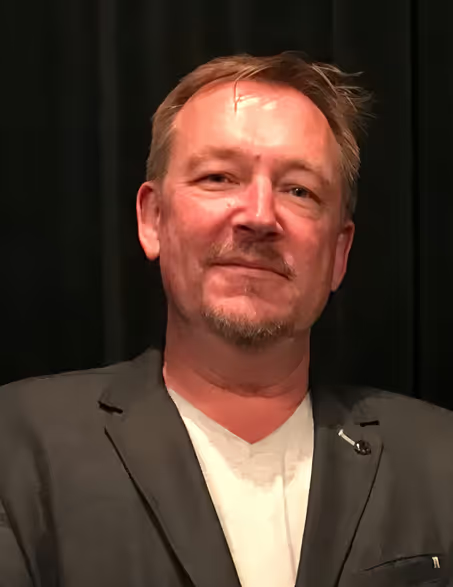

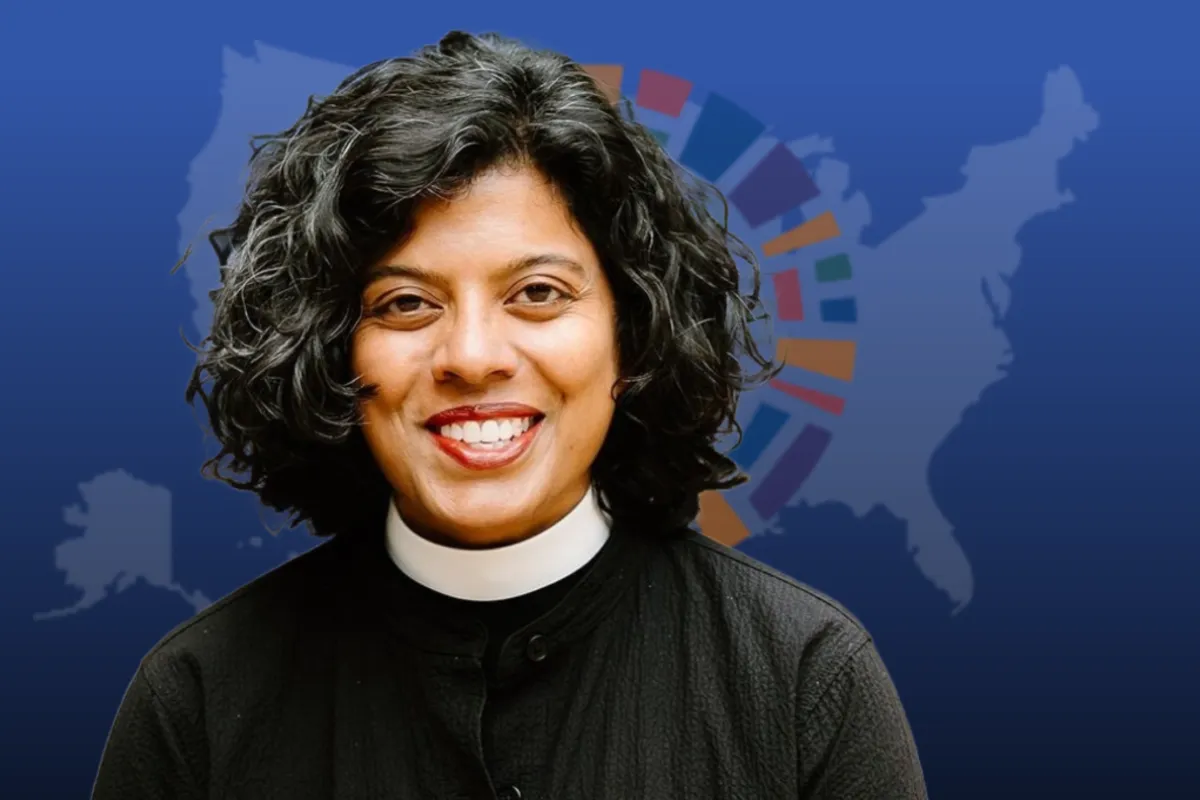
This week on The State of Belief, host Rev. Paul Brandeis Raushenbush is joined by the Very Rev. Winnie Varghese, the first female dean of the Cathedral of St. John the Divine in New York City. As a queer Episcopal priest born to Indian immigrants, she brings a unique perspective to the challenges and opportunities facing faith communities today.
In this episode, we dive deep into her journey, the significance of her role, and the current state of faith in America. Here are three key takeaways that resonated with me:
- The Power of Belonging: Rev. Winnie emphasizes the importance of creating spaces where everyone feels they belong. The Cathedral of St. John the Divine is not just a historic building; it serves as a beacon of hope and inclusivity for people from all walks of life.
- Integrating Identity and Faith: One of the most profound moments in the conversation is when Rev. Winnie shares her experience of realizing her call to the priesthood and embracing her identity as a queer woman. She highlights that these aspects of her life are not separate but are deeply intertwined. This integration of identity and faith is crucial for authentic ministry and serves as an inspiration for others navigating similar journeys.
- Responding to Current Challenges: In light of the rising tide of White Christian nationalism, Rev. Winnie calls for a proactive approach to ministry that emphasizes advocacy and community-building. She discusses the importance of addressing social justice issues through action and engagement, reminding us that faith must be lived out in tangible ways.
Don’t miss this enlightening conversation that challenges us to rethink our roles in our communities and the broader society.
More About the Very Rev. Winnie Varghese:
Rev. Winnie is the first female dean of the largest cathedral in the United States, the Cathedral of St. John the Divine in New York City. A graduate of Union Theological Seminary, Rev. Varghese has held pastoral positions in Atlanta, Los Angeles, and at several other New York congregations.
Transcript
REV. PAUL BRANDEIS RAUSHENBUSH, HOST:
The Very Reverend Winnie Varghese is a queer Episcopal priest born to Indian immigrants. She is now the first female dean of the largest cathedral in the United States, the Cathedral of St. John the Divine in New York City. A graduate of Union Theological Seminary, Rev. Varghese has held pastoral positions in Atlanta, Los Angeles, and several other New York congregations. Even as some Christian denominations in this country are taking overtly anti-minority and anti-women positions and joining the culture wars, elsewhere stained glass ceilings are being broken - and not a moment too soon. For her unique insights on this moment, I am delighted to welcome the very Rev. Winnie Varghese to the State of Belief.
Welcome!
VERY REV. WINNIE VARGESE, GUEST:
Thank you, Paul. Thank you so much for inviting me. So happy to be with you.
PAUL RAUSHENBUSH:
I've been a fan, now, I don't even know how long. It's been decades, now, that we've kind of known each other. Our ministries have passed through one another and overlapped and it's just been such a joy, and I think I joined everyone else in the country that, when it was announced you were coming to St. John the Divine, I was like, hallelujah, that is the perfect, perfect person to take that incredible space, that incredible legacy, and to meet this moment with that whole place. So congratulations.
We're recording this around Thanksgiving. I'm so grateful for you, and I'm so grateful that you were willing to take that pulpit, because it's a pulpit, all right! How are you feeling?
WINNIE VARGESE:
Well, first, thank you. You know, I think people like you and me that went to Union back in the day were the last people anyone would have suspected would be in roles like this. And I think we know each other as people that are off, a little bit, on the outside of things in some ways. And that's very moving and confusing in some ways. And frankly, I'm going to include you in this. I think you and I are exactly the kind of person that can meet this moment because of the lives we've lived. So I'm very honored and grateful, and I feel like I'm in exactly the right place.
PAUL RAUSHENBUSH:
You truly are. I have to say, already, I have seen the difference. And you've only been there, I don't know, a couple months, three months. And it's just alive. Even just online, you just feel it. But everywhere.
How have the first few months been? Because from my vantage point, as someone who's actually invested in the cathedral and the success of the cathedral and appreciate what it brings to New York City, how has it felt to step into that pulpit as the first woman, first queer, as far as we know?
WINNIE VARGESE:
Unlikely.
PAUL RAUSHENBUSH:
We'll leave it at that. And from an immigrant background, a person of color… So talk a little bit about what it feels like to to step into that pulpit and say: actually, I'm here.
WINNIE VARGESE:
You know, what's interesting is, for me - because it's very moving how many people around the city and around the world and around the country understand that cathedral as for them. It's important to them. I've not had that experience anywhere else, and I've been in some big places. So not just that they think it's an important place, but they think it's for them, and it's a beacon of something important about the Gospel for them. That I find fascinating - including people that aren't religious, or from different religions.
So when I was a chaplain at Columbia, which was 2003 to 2009, that was my Sunday assignment. And I remember when the bishop said that to me very casually, like, well, you'll go to the cathedral on Sunday mornings, I was like, holy God, no. I don't know how to do that. I know that pulpit and that altar, and I felt completely inadequate, but I was assigned to do it. So I'm familiar with it. I think what I'd say is different is I was a young adult trying to sort out what my voice was, what I was allowed to say, what the questions were, what the questions were we were allowed to bring into that room. And I came back for the bishop's installation about a year before all of this.
And I don't feel like a young adult anymore trying to discern what we're allowed to ask. I feel like I'm in a community of people that share the same questions and share the same principles. And the Cathedral of St. John the Divine inadvertently has been my model for what ministry is, my entire ministry, I think because it was in the neighborhood that I went to seminary, and because, in my tradition, it's a particular beacon for an expansive, really broad-minded, curious, kind of full of pageantry yet humble kind of Christianity, which I realized coming back, I have tried to recreate everywhere I've been. These are just my values.
So stepping into a pulpit in a place where it's actually who they mean to be, like everything I care about is who they mean to be, just frankly lets you be - I don't know if people ever got to do this; I get to be myself there, bring myself fully. Maybe there's a kind of person who assumes they can bring themselves - or maybe not, frankly. Maybe also all the White men in there have brought a little part of what they were allowed to think about to the pulpit, of what they thought God would see or what the system would bear. I literally feel like I'm bringing my whole self and really open to how the Spirit moves.
And, you know, there have been brilliant people there in the past, and even very recently; and there are, on staff - all that is true, very competent, very able people. I think the difference I can bring is I literally feel like I can bring my full self. So when people are hungry, we can feed them. When I don't know how to make sense of Saturday, I can bring it in. And there is something really powerful about - well, you know this as a preacher, when you offer yourself fully as a preacher, the Spirit moves. And to bring that into a space like that, into a pulpit like that, it feels like such a privilege and an interesting kind of confluence of things.
PAUL RAUSHENBUSH:
I love every way you talked about that. And one of the reasons I became a minister was, I was at Union and as you could appreciate, I was like, I'm too much of a freak for the ministry. I'm never going to be a minister. And then I went to work at a small Baptist Church, Madison Avenue Baptist. And in that place, I saw so many people who the rest of the city had no place for. People who didn't speak English, people with HIV, people who are homeless. And yet on Sunday morning and throughout the week, they knew that they were fully a part of that church. And I think that that's what I hear you saying about St. John the Divine.
And I'll just say, my husband and I, we have a little compartment for our ashes. We're in the Columbarium. And part of the reason is that because we can be. And because Brad, my husband's history with New York goes back to the 70s. You know, he just wrote a biography of Keith Haring who died of AIDS and had his memorial service at St. John the Divine, because he could. And that's what I think you're saying is, this is a place where people could come into. And Brad used to spend a lot of time there because he went to undergraduate and graduate school at Columbia and that was his church and his community. And so I'm so glad you're there.
But you've been on a journey to get here. Why don't we go back? Where are you from? I think you're from Texas. I mean, am I right about that?
WINNIE VARGESE:
I'm in Dallas, Texas right now.
PAUL RAUSHENBUSH:
You are recording this from Dallas. So when we talk about journey, it's not just a metaphor. It's real. So tell us, tell the listeners a little bit about where you come from - because I think that's so important when we talk about bringing your full self. It's all of what we bring, you know, and not all of it is like smiley-happy - which is, if all of us at church are smiley-happy all the time, church is wrong. We missed it. So tell us where you're from.
WINNIE VARGESE:
So I'm sitting here in the DFW airport, which I've spent a lot of time in my whole life. My parents live in Dallas. I was born in Dallas. My dad came to the U.S. in 1970. My mother in 1971. I was born in 1972. And we ended up in Dallas because my dad had a brother who was here, and he came to this country to go to college as a returning college student, I think he was 30 or almost 30. Went to Arizona, which is where he was first sent. And he decided, after having lived in Calcutta - my mother and father met working in Calcutta and Orissa, which a tribal area - working together in different areas of development there, that after they got married and he came to Arizona first, it was too hot. And my mother would find it too hot.
PAUL RAUSHENBUSH:
Oh my God, when you come from Calcutta and Arizona is too hot, I think that tells us something.
WINNIE VARGESE:
It's our family story that Arizona is too hot, unlike India. And so he was looking for somewhere else to finish school and he went to Dallas because his brother was there. And there's this picture that we found recently of these first six families that came to Dallas from our community. And we're all babies, they're holding us as babies. And there's a professor at the Perkins School of Theology at SMU, at Southern Methodist, who was really interested in international Christianity, world Christianity. Really interested in the Church in India, had brought doctoral students over from Kerala.
And like many immigrant communities, because there was a guy there, when other people were thinking about immigrating, they're like, well, there's a place we know someone. And so there are these sweet six families and our moms are thin and in their early 20s and have their saris on and are holding their babies and everyone's just so young and has shiny big hair. It's so great. And they were it. How courageous of them. They were it in the whole city of Dallas.
And this is the early 70s, you know; the city is still segregated, fighting school integration. And we're from South India, we're dark -people that showed up in Dallas. And my mother was a nurse and my dad was in school. And I think they thought my dad would finish school and they'd probably go back to India. Because in that generation, you wouldn't have seen that multigenerational migration in our community yet, even though our community does tend to migrate around the world. And it just never happened. Every spring they would talk about going back, every spring, every summer. And so we visited a few times, but it just never landed. So very unintentionally, I grew up in Dallas.
I lived in India for a few years, between like one and four, because they did think they were going to go back. And so Malayalam is my first language. I got to live with my grandmother and my mother's siblings. So I feel very close to India. So I have this weird almost-migrant experience, except that I'm an American. I was born in Dallas. And I came here for my fourth birthday, and there are pictures of it. And I remember having to learn English very intentionally so that I could be admitted to kindergarten. Because my parents were putting me in an Episcopal school, and I had to learn English to go. And I grew up in Dallas, in the suburbs of Dallas.
PAUL RAUSHENBUSH:
And as you said, that must have been fraught. I mean I saw the television show Dallas growing up, and I didn't see you in that. That was not the image of Dallas that the rest of the country was getting. And I can imagine that that must have led to a really interesting perception of insider-outsider, and how do I navigate this world which doesn't seem to be made for me?
WINNIE VARGESE:
Well, you know, the politics of it are really interesting, and I've not spent enough time in Dallas as an adult to really explore it. But one of the things I find interesting is, when you look for a place to live, people have to show you where you can live. So when my parents wanted to buy a house… And also a very different economy: my parents bought a house while my dad was in college, because you could. Because you could. You can't do that anymore.
So someone had to show them neighborhoods. And what's interesting to me is they didn't take them to Black neighborhoods, which I think is fascinating. Because Dallas was absolutely redlined at the time. You couldn't just walk up into the city of Dallas and with your Brown self and offer to buy a house. And I think it's so interesting how different life would have been if they showed us Black neighborhoods. I'm so curious about what kind of solidarities would have formed.
But instead we're way on the other side of town in a working class White neighborhood, working class, middle class kind of suburb, not upper middle class at all, that's newly developing, full of - you remember those early 70s homes that was very like Brady Bunch kind of style homes, ranch, lots of space, lots of yard, lots of people of the same exact same income bracket. And when I was growing up overwhelmingly White.
I remember when Black people moved onto our street, but it was like one or two. I was well into adulthood when a family from Venezuela moved across the way and they came over and brought my parents a casserole because they thought they were Spanish speakers as well. It was very exciting. And they were very disappointed. But I was far into adulthood when that happened.
And the people that were Mexican-American, often many, many generations, there was a whole neighborhood where they all lived. They came to our high school. And you would not have encountered them until they made that move. It was very slow in that segregation disintegrating. And now Dallas - like Houston - one of the most diverse cities in the country, really exciting place to live, great place to eat, all kinds of folks.
PAUL RAUSHENBUSH:
I was in Dallas recently, and someone who really knew the city was taking me around. And I was like, oh, this is really interesting, in a way that I had not… I was locked in I don't even know what era; but yeah, it is interesting - and I think we can say it - it's interesting because of how many people have come there and made it more interesting, all together made it more interesting. And I think in some ways that experience of slow integration, but also real understanding of what that takes, must really, you know, it translates to ministry in some ways.
And even just a person coming into a place like the Cathedral of St. John the Divine, which is such a magnificent space, but what I love about it is that it also has the appearance of falling apart - not inside, but you know, it's still being built and it had a terrible fire. And so it's not one of these places that is the perfect place and nobody can step inside because you're going to ruin it. In some ways, it feels like a place that… Well, actually, this place kind of needs me. And I love that as an immigrant ideal, or like everybody, everybody come. The place needs you to be what it needs to be. And I do think that maybe your experience as - not to put words in your mouth, but maybe that your experience coming from that background really lends itself to the building of community in a place like St. John the Divine.
WINNIE VARGESE:
Well, I think part of what it means to be an immigrant of my generation, and I think it's different, different generations… You know, my friends, that I know as adults that grew up in cities like New York and New Jersey had a very different experience than I did, because there were enough of them for them to experience a really overt racism, which was more occasional where I grew up - which makes them feel like outsiders in a way that I don't. I have a very strong sense of entitlement to live in this country, which comes from, frankly, how few of us there were and that people didn't know how to make sense of us. So we were curiosities.
But I think, to your point, I think part of what happens when you're someone like me is you're always seeking out your belonging. And so you notice when other people are seeking, frankly - unless you're just a jerk, it's hard not to see it. And it feels like something you actively build all the time. It doesn't feel like a default, because my parents couldn't create that for me. So it's not just a way we know how to be. We were discerning it and translating it and translating it for them. And so the unspoken things and how you make family or community or belonging aren't unspoken for me. They're learned, which is why I'm articulate about them.
And I remember in seminary not understanding that that was distinct or unique enough to study. It hadn't occurred to me that everyone didn't do it. And I do think it's a huge gift in ministry. So the Cathedral of St. John the Divine, there are these seven… It's built based on the vision of John of Patmos and the Book of Revelation. And so there’s these seven chapels in the back. Each one of them could be a full-size church for the kind of church I grew up in in Dallas, and each one of those is dedicated to a different language group. And the one right behind the altar facing east is to the people of the east. But it's representing the seven nations in Revelation. But they are dedicated to seven of the language groups that were among the first immigrants to the colony.
So missing all the Black people and missing all the Indigenous people, I would say - and arguably Indigenous, not migrants. But we've got work to do. But it's kind of in the stone that we are a city of migrants and of immigrants and of language groups. You know, the building itself contests the contemporary kind of White nationalist version of who we are and how we've come to be and what our heritage is. And that was done on purpose. The cathedral was built at the same time that Union was being built. And that was a very particular moment before fundamentalism; it was the era right before Walter Rauschenbusch when the nation was churning with immigration and kind of deciding who we would be, whether we would consider science and the academy as serious tools to consider our faith and our politics was in the same kind of moment we're in right now…
PAUL RAUSHENBUSH:
Can you give a decade?
WINNIE VARGESE:
It started in 1892, and they built the undercroft. And then they've taken time. They've stopped many times. So there was another big push in the mid-1900s, like 1911, 1912, 1918. And those chapters go up then.
PAUL RAUSHENBUSH:
That was a very, very kind of a big time and a very challenging time in New York. Deep poverty, incredible immigration coming into the city, which was a source of big tension and just industrialization. It was kind of chewing up and spitting out people. And I actually view that time as a very interesting time to think about our time now. And that is history I actually had not put together. Thank you for mentioning that.
PAUL RAUSHENBUSH:
Okay. I do want to ask you about call. I know that feels very first year Union. By the way, we're saying Union and Union Seminary. Union Theological Seminary, we share that alma mater, and I think I was there earlier than you, but anyway, it's a seminary which shaped, I think, both of us in different…
Everybody comes to Union and then they have their experience. And they still do, but I am curious: how did you get to ministry? I love that question for people who assume the pulpit, and it seems all very like: and then I did the next right thing, and then I did the next perfect thing. And I just want to disabuse anyone out there - especially if you're thinking about seminary, or if you're feeling like, ah, maybe I'm interested in this - there's not the right way to do this. There's just many paths. So can you tell us a little bit about how you felt drawn into this world?
WINNIE VARGESE:
Yeah, I love the way you put it. I had to send my bio to something recently. And the way you write a bio, it looks like it all made sense. And it was: you made the best choice every time. And I feel like you want to put underneath some of those… There's the transition, and then there's really: what a weird thing to do. Like, what a bizarre thing with no obvious end was the next step, right?
So when I went to college, I went to college in Atlanta, which is why I just went to Atlanta. But I went to college in Atlanta because I thought I was going to work in international development in some way. And I didn't think, frankly, I was smart enough or hardworking enough to be a doctor or work in the sciences in development. So I thought I would be on the politics and government side. I really cared a lot about that. Maybe on the economics kind of side, just what my dad studied.
And the Carter Center was there. And so I wanted to intern at the Carter Center, and that was how I picked my college. I thought I would do that. And in my first year, Paul, I had the most literal call to experience, as someone who literally, and to this day, doesn't believe in them. I don't believe in them. That's just not how life works. It doesn't make sense to me.
But what happened was I was reading for a class, a Women in the Hebrew Bible class that Tina Pippin, who was an Episcopal deacon, taught. She still teaches there, a brilliant, brilliant scholar of the Revelation, of all things. And she handed us the reading list in that class. I mean, it could have come out of Union Seminary. Alice Walker was on it. Audre Lorde was on it. I had to read the Cancer Journals as a 17-year-old. Carter Hayward was on it. And then all these, you know, the Tribble and all the great biblical scholars.
I loved that class. I did not expect to love that. I loved all my classes at that age, but I love that class. Then I was reading, I've told Carter this, I was reading one of Carter's books. It was an assignment for classes. I had to read this chapter. I had to read these four chapters, whatever, sitting on the floor of my dorm room. And I swear it all came together. It all felt like this integration in my body. I remember thinking, oh, I'm going to be a priest. I remember thinking, are women priests? Is that a thing? I was like, whatever. But it was so clear, I was going to be a priest. It's like, huh.
And then literally, the next thought was like, Oh, I'm gay. That's what it is. Oh, that makes so much sense. And I literally felt like I wasn’t a miserable person. I felt like I entered my body. Like I was literally enfleshed, as Sean Copeland would say. And it felt so solid and true. But I thought of calling my dad and saying, “You're going to be so excited! I finally figured out what I'm going to do with my life. And it feels like a call, not just a logic out. And you're not going to believe this: I'm gay. Doesn't that make so much sense?” And then I thought, well, maybe I should wait before I call him. And I'm really glad I did, because that would not have been a good call, I think.
PAUL RAUSHENBUSH:
Those things together, though, let's not lose that enormous thing, because often it's like, I cannot do this because I'm gay. You know, even though I can have this big call experience, but I can't do it because I'm gay. For you, those things came together. And that is so another thing about, what does it mean to be integrated? And what does it mean to show up fully? And to recognize that that is actually what makes me the kind of priest that I am and the kind of follower of Jesus who I am, or however you describe your faith tradition, your faith experience.
I think that so many of us spend so much time trying to bring these things together because so many people have told us that they're separate and they can never be reconciled. And what you're saying, and I think it's such an important testimony for our listeners to hear, is that those things, actually, were the same thing for you.
WINNIE VARGESE:
It has never occurred to me to separate them. And I have a brain and ears, I hear how I should. There's never been an option for me. And so I have been told by people, I think overwhelmingly, who are trying to do the best thing for me, my whole career, I've been told to be closeted. I've been told to be quiet about… I've been told to do certain things so that I can work. I was told by one person, I think their version of that was, don't do this now. Go live your life and enjoy it and be successful and come back, basically, when you're done. And I think what he was saying is, it's been really hard to be me my whole life, as a very senior person in our church.
But because that happened at the same time, and it was 1989, so I was a person who had grown up watching AIDS on television, on the news in Dallas, watching our president talk about it, watching ACT UP. I had no doubt in my mind whose side Jesus was on in that, like very clear - I was raised in the Church by progressive people - really clear. And so that language of silence equals death was the language - and integrity - was the language of my growing up. I was formed by it.
And so by the time I have this realization about myself - and I think one of the reasons it came all of a sudden is I think I kind of, my brain or my heart protected me. I could not have, if I knew those things in my parents' house, I don't know that I could have lived. None of those things is acceptable in the community I come from.
But also, frankly, because I was such an outsider, I didn't see myself reflected anywhere. I didn't want to be like the priests I grew up with. That wasn't what I wanted to do. Because I didn't see myself anywhere, I was protected from, I think, the comparisons that particularly women grow up with of what you should be like, and it can really torture people. Nobody was like me. I couldn't be like any of the people around me. That was so clear to me. So in some ways, it really protected me, but also created this moment of such integration that I have confidently walked into my call with a sense that everybody could reject it. Like, whatever, I'm already, my family's already, I'm rejected. I come to this objective.
PAUL RAUSHENBUSH:
What do you think you got that I haven't heard before? I mean, I have faced bigger giants than you.
WINNIE VARGESE:
I remember saying to my bishop in Los Angeles - and the great thing about being young is you don't realize how arrogant certain things sound, but I meant it authentically - I've lost everything. I don't have a family, is how I understand, at least internal to myself, I know that If I am myself, I've lost all the things that are my anchors. Why would I - and I'm sure I cursed when I said it - why would I lie for the Church if I'm not lying for my family? Like, who are you? And there's another way I could have done this, and it would have been fine. I could have been ordained in Dallas, closeted. I'm too Brown for them to ever think about my sexuality. I could have done that. I have to be honest, it never occurred to me, and I'm so grateful.
PAUL RAUSHENBUSH:
I think that - it's not a miracle because that seems like it's out of the ordinary - it's actually a miracle that is in the ordinary, but it's you being able to move this way and what it means for the future people of the Church that we can really move this way with where it's completely integrated. And what I try to say, you know, because it's a very different story just because I thought Church was kind of dumb and boring and for a lot…
WINNIE VARGESE:
Me too, Paul. I have to say this is the thing that killed me about the sense of call. I had rarely if ever gone to church that was in English, which is the only language I speak. So I went to boring, irrelevant, conservative church in a language I don't speak my whole life. And I was like, oh, I'm going to be a priest. I don't know.
PAUL RAUSHENBUSH:
I mean, how amazing is that? But, you know, I was just like people like me never… That's just the wrong thing. And it would be gross. And even up to the very end, I was serving a church that was kicked out for welcoming gay people. I was like, you know, who needs it? Who needs any of this? But what was so interesting is that I realized when I just spoke about my trajectory was I've actually - and this makes me so, I know I'm so lucky and so unique, but maybe, hopefully, less unique as we go along. I've never actually worshipped or served in a church that was anti-queer.
WINNIE VARGESE:
Yeah, me too.
PAUL RAUSHENBUSH:
And that's wild. And so when people talk about the tradition or traditional Christianity, I'm like, I don't know what you're talking about, but I've been alive for - I'm older than you, but I've been alive for 61 years. I've never heard anything negative about queer people from the pulpit. Ever. But those are the churches I've served. Those are the churches I've attended. In fact, it's been just the opposite: going to Judson Church in New York City during the height of the AIDS epidemic, and we were making packets for IV drug users. I mean, that was our ministry.
So I think it's important for all, as we think about Christianity and this moment when there are White Christian Nationalists who are using the rhetoric of: this is who we are, this is who we've always been, and this is the tradition in America, and we're the traditionalists. I'm like, not to me. Not to me. I think you represent that. There's just another way to think about tradition and also call and what God is doing in the world.
You've served in so many interesting places. We would be remiss if we just blipped over the Disco Mass. I mean, this is a great career that Rev. Varghese has had, which includes being the rector at St. Mark's in the Village. One of the great things about that church is that it was a place for dance. It was a place for poetry. And it was also a place where a lot of people were able to celebrate Mass for AIDS deaths, which for me is, like, if you were a place that turned that away, that's just not going to be a church for me. You can figure out your future, but that was bad. But St. Mark's, and you all, in the proximity of Pride every year, you had a Disco Mass.
And I was at Huffington Post at the time, and I brought all these young journalists, queers, who were just like, I am not going to church! I'm like, well, you're going to go to this church. And they were like, okay, I admit it. That was awesome. So your trajectory of all these different locations, some of them very big steeple. I mean, with your queer Brown self going to some major steeple and breaking major new ground. How has that been? And then I want to get into this moment in New York, which we're both very aware of: how has it been, to kind of knowing how integrated your call is and who you are, going to spaces where that might be new to some people?
WINNIE VARGESE:
The point you made about White Christian Nationalism and their kind of call on tradition, I read an article recently about, in England, how their White Nationalist Front, you know, England First, is claiming the Church of England and that tradition as theirs. And so pushing really hard anti-gay, anti-immigrant, anti-women; and saying, kind of clearly: they're not religious. They don't believe in any of this stuff, or they don't get it, but it is the carrier for English identity.
And that's what's happening here, too. And they're not playing around. I mean, they're very clear. They're saying it out loud: we're going to take back the Church, because that's where identity is held. That's a really powerful thing to say about how national identity works. So White Christian Nationalists are doing the same here in the same way that the Moral Majority and others… These are not folks that are religious. They're just using religion as a tool - very effectively. The great danger in it is that thoughtful people believe that that is what the Church is. And it's a great danger of this moment.
I agree with you: what we're doing is what Church is. What we've all been doing. And I think, back to where we started from: I remember a job I didn't get, I wasn't offered, once, because they said: we don't know who your friends would be here, how you would make home. And I remember being really offended - I was very young - being very offended and thinking, oh, they're all White. They, the people making this decision, are used to being around people like themselves and can't imagine how someone could function without people like themselves.
There aren't people like me. I'm a unicorn in the world. There's no one like me in the Church to make community with. And so because there's not - I don't find that painful; it just means I have to go be very intentional about the community I make, which I think is what all the queers of our generation did. We went and made community - very problematically and whatever, but we did, right? And so every place I've gone, I've never assumed that I make sense to anyone, but I also don't feel like it makes any sense to explain yourself. So I try to do the work and I'm a believer in the very traditional sense that I believe God is here and God is with us and God demands something of us. And if I'm seeking that with you, that's the work.
PAUL RAUSHENBUSH:
Yeah, and also really old school that I so appreciate you saying that, because we had lunch a couple weeks ago and just the way you were talking about this work, saying God is going to work here just as God worked at your last church in Atlanta. And if you come into a situation where you truly know that, then people will come along - because they'll be sensing, oh, I want to be where the Spirit is. I want to be where the joy is. I want to be where the truth is. I want to be where the Gospel is. And I want my life to be transformed in community. And I think that bringing that into every space, it goes back, honestly, to your call. It's like, (sings) it's all in me.
WINNIE VARGESE:
When I went to St. Mark's, I think I thought it was a Pride Eucharist. It's very Episcopal of me because it's the weekend of Pride. And I tried to make some changes and I was listening to what was happening. It took me a minute to realize, oh, it's a tribute to disco. It's not Pride. It's a tribute to disco. And part of what that is, is that's a whole bunch of people like us making community. And so the reason that music works in the liturgy - and you don't have to tweak anything - those are just disco anthems played, and it works. It 100% works.
PAUL RAUSHENBUSH:
It 100% works. And we're going to get into it here for a second. Because I, you know, when I was at seminary, and well before, of course, I was going out and I would go to the clubs where the DJ would lift people up and people would come together on the dance floor and experience that sense of joy, that sense of community, that sense of: I truly am whole and no one's going to tell me otherwise and all those anthems. And that's the reason, frankly, the Pulse shooting in Orlando hit so hard is that it's like those are, in some ways, very sacred spaces where people can come together. And I've always used that.
I did a lot of this kind of ritual and performance at Union; it was like: how do we create these places where, truly, beauty and love can erupt? And I really think that's one of the the core spiritual sustenances of St John, I really do, and that is people coming together. I just had a friend who was a pallbearer at Keith Haring's funeral who just died. And he had been living with HIV for a long time and just had, it was kind of an incredible life and meant a lot to a whole bunch of people. His funeral, his memorial service was in St. John the Divine, and people who haven't stepped foot in a church, I guarantee you, I guarantee you, were there and said it was one of the most beautiful experiences they've ever experienced. So it's still happening.
But let's talk a little bit more about the present reality in America. And you know, my listeners from this show have heard that we don't need to introduce what White Christian Nationalism is to them. But I do think what I'd love to hear from you in particular in this, the richness of this conversation is, how do you understand what we should be doing now? You know, using the kind of pulpit you have… We're in a city that, basically, Trump is sending ICE. We have ICE here already. Trump has threatened the National Guard. There is a sense of threat impending, and I'm just curious how you are thinking not just of what a normal person starting a new pulpit would be like: let's try to learn about the community and build a space and welcome... But we're also in a moment in our national history, national psyche and also our city - how are you approaching that work?
WINNIE VARGESE:
One of the interesting things about a cathedral is it's not a parish, right? In our system, it's not a congregation. It can have a congregation, but it's not a congregation. It is a building and a center of the diocese, and the dean in a very traditional sense, for us, is the senior cleric of the diocese. It's the bishop's seat. And so there is this sense that that role and that building should proclaim; whereas a parish has to, there's an internal logic to a parish, to a church.
We don't have that as much as we have this massive building. And one of the ways I've thought about ministry everywhere I've been is; what is the scale to this? What is the scale to be the chaplain at Columbia? At what level does this thing function? Is it for undergraduates, for graduate students, you know, how are we thinking about it? For St. Mark's of the Bowery, this great historic place full of arts, where do we stand today?
The cathedral, from its founding, like Union, took a position in the great conflicts of the time about what faith was for. And it's on the same side as Union. That it's an intellectual light, in a high place for the city of New York as it is. And there was a time Bishop Manning, in the 20s or 30s, built a full-size interior of a tenement apartment in the narthex, the entryway of the cathedral, so that the high and mighty that attended the cathedral, which is who attended the cathedral at the time, had to walk through a squalid tenement to get into the cathedral.
PAUL RAUSHENBUSH:
I had never heard that. That is a great story.
WINNIE VARGESE:
And we're full of stories like that, where it's a place where the needs of the city show up on our steps, inside the building, and we use our bullhorn and our massive, massive decorated pulpit, in our front steps, to proclaim to the city that if we believe God is here, you know, what is God's will for us? What is God's justice in this time?
So the way I've approached it, one, is to really highlight Sunday morning - and in this particular moment, I think one of the ways you resist the kind of politicizing of all of our lives is you invite people to come together. So it doesn't mean we tolerate everything. We definitely don't tolerate bigotry in our spaces. Everyone is welcome. We will proclaim a vision of a city as we should be. And I think it's an important time to name Christian values and what it would look like to live them out, what our advocacy should be towards, how we serve people near us, of how we think about what's being said and done in our name.
I'm really excited, frankly, to have a new mayor, a mayor that wants to build in this city. It's really fun in a big institutional life be able to build together. We can also critique and build little. It's much more fun to build together and build something of great scale together. You know, how do we feed people in our city? And how do we feed people in a sustainable way that isn't prone to, you know, just the federal government deciding that it can change it? You know, like, how do we Think about it, frankly, in a development model. What does self-sufficiency and sustainability look like for us in the city of New York if we care for our people? So I think that the scale is definitely of proclamation, but also of building.
So we, maybe an example is when we realized, at the end of October, that SNAP, that LuxSnap actually might be cut, which I didn't believe till the very last minute, because I remember Mrs. Edelman saying, this is how it's all tied together so that it cannot be stopped. It's never been stopped. So it was right before, like maybe the 31st or the 1st, where we're like, hey, wait a minute. This is going to happen. Might've been the 31st. And so I brought some people together from the cathedral and said, I'm going to put out a call to raise money. So we're going to send it out on all our channels and say: if you give us money, we're going to get it out the door to people that are hungry. And we're going to do it by buying $100 grocery store gift cards.
I wasn't even sure something like that existed. It was like, someone go find out to our local grocery stores, because we know that one of the impacts of something like this is our grocery stores lose business and then they fire their people. And so we're going to buy a hundred dollars because we're going to assume it's going to be over soon. And I can make a $10,000 gift from my discretionary fund to get us started. Let's announce it. We'll have things for Sunday. We'll come on Sunday, which I think was November 2nd. We'll have these cards for them and let it all be over by Monday. Great. And if it is, the money will go to our food program. And if not, we'll be equipped every day and we'll just give them out till we're done and apologize. And it'll be really slipshod and fast and not as fine as you would normally do something at the cathedral, but we'll know that people that expected money to come on November 1st, and who knows how long they've been out of money, will be served on November 2nd.
We raised $250,000 in two weeks and got every penny of it out the door before it was over. That's what a cathedral can do. Your parish can put out that call. St. Mark's can put out that call. It's going to be hard. We might raise $1,000 and we'd be very proud, or $1,500. We might get some groceries. It takes a lot of coordination for most of our churches to do things like this. We just have a massive pulpit in every way at the cathedral. So we could get all kinds of need organized really fast. People found out about us. We got all this news coverage, frankly, because people could see us. They could see our lines.
I saw a guy with a camera behind a tree, kind of behind a bush. So I went over to say, hey, and ask who he was. And he was like, well, who are you? I was like, right. So I told him who I was. And he was from Channel 7 or something. And he was just pretty sure he wouldn't be allowed to come in and was trying to do it with dignity. But we invited everyone in. And so then we got covered. The coverage means that more people know, which means you could help more people. And then it just spiraled. And literally a woman said to one of the guys that works at the cathedral - on a day when we had invited everyone inside, because it was too cold to stand outside - so everyone's just sitting where you'd normally sit as a congregation, literally coming up to where the altar is, where we had propped up some plastic tables and were handing out these cards. But he gave someone a hundred dollar card - this is like a week and a half into this crisis. And she grabs his arm and says, “God is here.” It's like, yeah, yeah, because you are here, God is here. This is what God looks like. I was hungry and you gave…
PAUL RAUSHENBUSH:
That is a great example. Also, it does show in sharp relief, frankly, the difference between, somehow, the leadership in Congress, Mike Johnson, who claims his faith very strongly, saying SNAP should be cut - which, by the way, the money is there. The money was there, let's just be clear. I think our listeners understand that. But the money was there. They're just deciding not to give it out. And literally making people hungry, versus this ministry, which is about God is here. And I just think that it's really important. You want to talk about tradition?
WINNIE VARGESE:
You want to talk about feeding the hungry? Feeding the hungry. Like, literally, I think all those guys are Catholics. There is no Catholic Bishop that will tell you, no Catholic Bishop that will say, leave a hungry person hungry. I mean, come on, here…
PAUL RAUSHENBUSH:
And that's been interesting, actually, to see the Catholic bishops trying to make sense of this administration when JD Vance is out there saying, I'm more Catholic than all of you.
WINNIE VARGESE:
He's more Catholic than the Pope, apparently.
PAUL RAUSHENBUSH:
Two Popes. It's hard to do that. It's hard to get two Popes to refute you. I mean, you have to work. You have to work hard to get two Popes. But even Cardinal Dolan, who I disagree with on many, many things, he's out there. He's saying, no, no, no, this is not us. I think it's been very interesting to see those kind of coalitions. When you see the attack on immigrants, especially, that's something the Catholic Church feels very strongly.
For them, that's a bottom line. It's analogous to abortion for them, it feels that important. So one of the things I've said is, I don't think the administration thought that one through as far as the religious resistance, because there's been a broad religious resistance. You can't point to someone on the MAGA Christian side and say, oh, they have such soaring, inviting rhetoric, I really want to be a part of that. You know what I mean? There's no beauty in that. And they just don't have anybody who can truly represent faith in a way that makes sense to anyone. It's all about: we're taking books off the shelf. We're cutting your SNAP. We're building a ballroom gilded with… I mean, it's the gilded age. It's exactly the gilded age. it is wild.
WINNIE VARGESE:
It's what's called empire, I believe. I think what's shocking about it to all of us is there's no veneer of civility, which is what we're used to. Yeah, there's none of respectability.
PAUL RAUSHENBUSH:
The religion on the other side, there's nothing to me appealing about it aside from its power and an effort to wield power and to maintain power.
But listen. I am so excited about being in the city and you know, Brad and I, we baptized our kids Episcopalian; you know, I'm the Baptist in the corner saying, fine with me. And we will come up to the Cathedral soon and Brad was just there for his friend’s memorial service and anyway, I'm just so grateful that you're there.
This is going to run on the weekend of Thanksgiving. Do you have thoughts about Thanksgiving? How is the Cathedral observing that that day?
WINNIE VARGESE:
You know, it's interesting. So it's one of the few national holidays that actually has a… You know, Episcopalians, we do everything by our book. And there's actually prayers and there's readings for that day. We don't tend to have that. We tend to stay off the national calendar. We do a sort of liturgical calendar. But there's basically a service for Thanksgiving. I don't think we actually have a history of doing anything special there, which is interesting. We must have at some years. We don't right now. I'm guessing it's post-pandemic. We've never rebuilt anything. But everywhere else I've been, you do a service that day because the prayer book has one.
It's a complicated day for most of us, right? How do we honor indigeneity and these really complicated stories of how this country came to be and our wrestling with that? And I think it's a good time to wrestle with all of that. And, you know, it's about family and, kind of ironically for most of the folks I know in church, family's hard. So, you know, coming together, I think people are really good at this, now, in a way that they weren't when I was younger. Almost everyone I've talked to about the holidays will say at some point: it's going to be hard. Family is complicated, how we are ourselves in family is complicated. That's a change for me in my life in the last 20 years of how clear people are about that.
But the larger principle of Thanksgiving, I know it's why the Church has a way to honor it, is that the holiday comes after the Civil War and Thanksgiving is reinforced after times of war in this country as a tool to try to bring the nation back together. To literally get people to sit down again together. Again, complicated because it's, how does the North and South sit down together again? They mean the White people, of course, complicated. But that sense of a common national identity or markers of identity that we find together, I think that's actually a pretty great idea. I think it's complex and I think it involves the kind of diversity of the place I'm about to go to and really embracing it.
And I think this election in New York gives me a lot of hope that overwhelmingly we're a nation full of neighbors that is much more complex than our politics reflects, our national politics. And days like these, things like this, overwhelmingly in this country, people are sitting around pretty diverse tables. That's across class. That's kind of what our nation actually looks like. So I'm hopeful that in having those experiences, we have stories to tell.
And then part of our job is we have to tell the story. It's again, very old school Christian that we've got to testify to what we've seen, because Satan for sure is a liar and is out there telling a story and telling a story about us and about our faith. And again, this is much more traditional language than I would have used until very recently in my life. But the evil all around us, I think it's what we're taught about in seminary. It feels so concrete. And if I don't believe, I have to believe. I do believe that there's a force for good and there is a force of love in the world. It's the language you're using. It's so compelling.
And I think there is evil around this. I couldn't tell you how it exists, but it exists. And it is very articulate. And if we're not telling the story of what we see and making, creating experiences so that we have a story to tell that is different than the one that they are telling us. It's very compelling, right? Empire is compelling simply because it's powerful. That power is compelling to people because they're afraid. And Jesus says over and over, do not be afraid - because we are afraid. But I think our story is on the ground with one another in relationship with our neighbor. We don't have to be afraid. We're for one another. And we all know that experience, right? Of handing somebody a card and like, oh, I can change this for her. And in talking to her, she can change it for me. We don't have to be afraid of one another. Because they're not saying just be afraid of the guns. They're saying: be afraid of one another. Be afraid to talk honestly, to be yourself. And we have to narrate that.
In the movements of the late 1800s, the early 1900s, the social gospel movement, the settlement house movement, ACT UP, And we know for sure, the civil rights movement and all these liberation movement - the power of people of faith and the language of faith, whether or not they were overtly people of faith, like all my friends whose fathers were pastors or families were pastors who were active in ACT UP, that is Spirit power that was in that.
We know what it looks like to organize people because we come from that, whether we like it or not. That power, I think, is what I want to call up to this generation. and just be a resource for, and create a space for, the thing that we're wrestling with as a nation is who we're gonna become. The far right is right. It's on the table right now. I absolutely believe it will be a beautiful future. It's how ugly it has to be till we get there, and how we get there. And the thing they're fighting is everything we believe in. And we have to tell it.
PAUL RAUSHENBUSH:
The very Rev. Winnie Varghese is the new-ish rector of the Cathedral of St. John the Divine in New York City.
Thank you so much for joining us on The State of Belief.
WINNIE VARGESE:
Oh, thank you. Thank you so much for this conversation, Paul.