State of Belief
The Downward Arc of Donald Trump, With Ruth Ben-Ghiat
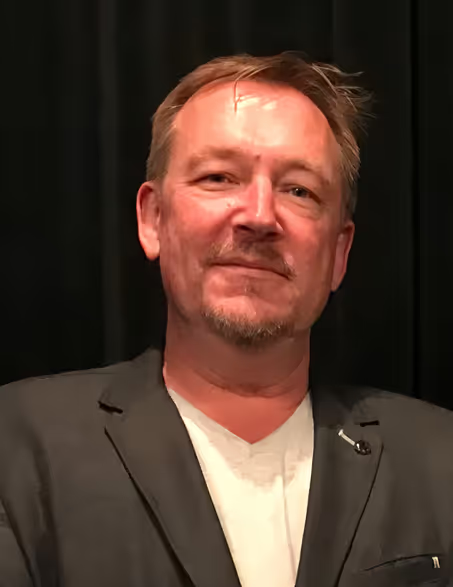

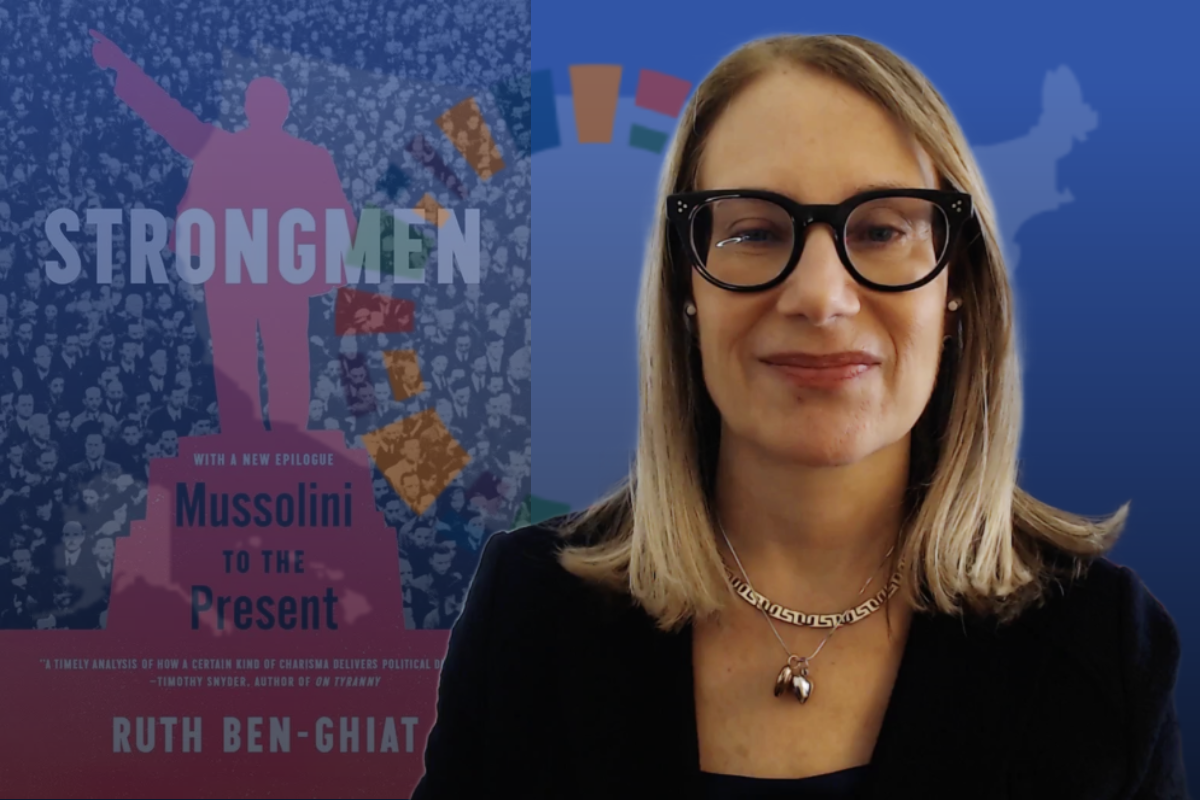
Virility and victimhood – how do these seemingly opposite characteristics prop up strongman leaders throughout recent history? Expert and best-selling author Dr. Ruth Ben-Ghiat connects the dots in a conversation full of wisdom and, ultimately, hope that the current attempt at authoritarian rule in the United States is on the decline.
The author of Strongmen: from Mussolini to Today, Ruth makes clear that war is often a cold-blooded tool of authoritarians – particularly if they see other means of consolidating power no longer work. Religious and spiritual language is also a near-universal tool in the strongman’s arsenal, making American Christian Nationalism just more of the same for anyone looking closely at the history of authoritarianism in the past century or so.
Inevitability is a cornerstone of the image projected by strongman propaganda. As Ruth points out in her book, The authoritarian playbook has no chapter on failure. And so self-delusion is an important part of keeping an authoritarian takeover in motion: nobody can stop this. In fact, most people are enthusiastically supportive of anything we do (regardless of what the polls say – sound familiar?)
So what hope is there for effective opposition? Ruth emphasizes that nonviolence is essential, and that collective action is required to break the hold most strongmen have over their followers and foes alike. With concrete historical examples and accessible explanations of what’s really happening today, she doesn’t shy away from making clear how high the stakes are – but also how real the possibility of shepherding our intact democracy through this crisis is.
More About Ruth Ben-Ghiat
Dr. Ruth Ben-Ghiat is a historian and professor at New York University who specializes in fascism, authoritarianism, propaganda, and democracy protection. Her writing explores how strongman leaders use culture, media, and corruption to consolidate power, in books include Strongmen: Mussolini to the Present. Dr. Ben-Ghiat is a frequent public commentator on threats to democracy in the United States and globally, and shares her insights on her Substack, @lucid.
Transcript
REV. PAUL BRANDEIS RAUSHENBUSH, HOST:
Dr. Ruth Ben-Ghiat is a historian, a professor at New York University who specializes in fascism, authoritarianism, propaganda, and democracy protection. Her writing explores how strongmen leaders use culture, media, and corruption to consolidate powers in books that include Strongmen: Mussolini to the Present.
Dr. Ben-Ghiat is a frequent public commentator on threats to democracy in the United States and globally, and I'm very happy to welcome you to the State of Belief.
DR. RUTH BENGHIAT, GUEST:
Thank you. Glad to be here.
PAUL RAUSHENBUSH:
So I really appreciated your book, Strongmen: Mussolini to the Present. I mean, you've written so many amazing things and you have an incredible Substack that I want to talk about later. But the book outlines an arc. It goes from getting to power, tools of rule, losing power.
Assuming that we understand ourselves in a moment of a strong man in America, where are we in that arc?
RUTH BEN-GHIAT:
Hmm. We're in a very delicate, dynamic moment, because we have a president who already had one term and then convinced everybody through propaganda, everybody being his followers, that he still was the rightful president during the Joe Biden years. And this allowed his personality cult to keep going even when he was out of power. And that's one reason they came back to power in 2025 and they have done more in a year than most other autocrats who come to power via elections.
But I believe that President Trump has been overstepping and overreaching and being very blatant about his corruption and visiting hardship on Americans, especially with this new war on Iran - and so he could be paying a heavy price. He knows this, which is why he starts talking about nationalizing elections. So he's under pressure and he has started his downward arc, in my opinion.
PAUL RAUSHENBUSH:
That is the most hopeful news I've heard today. I kind of feel that too. I feel like there's something about the overstep. He hasn't brought along even those who really supported him. And now there's a sense of the arc going down - but a lot of danger, including this war that, as we record this on Wednesday, appears to be expanding.
You know, war is such a tool of the strongmen, right? mean, war is such a part of the playbook, isn't it?
RUTH BEN-GHIAT:
You always want to know why are they going to war now, if the country was not attacked, if there was no provocation from outside. And often we find that when they start to realize that they're dropping in popularity, or there's some kind of corruption investigation or problem for them, legal problem for them that is imminent or they feel it, they're afraid of this, that's when they often decide to do some kind of military action. And the reason they want to do that is that by being in a war, you can decide you're going to have a state of emergency or do special things, have a state of exception.
you also hope that people will get behind you out of patriotism, because it's a war and our service members are at risk. The problem with this is that they didn't provide any kind of propaganda buildup. There's no rationale for this war. They didn't say much about it. They're casting about after the fact, even as they're telling us that it's expanding. So war can be a tool for the consolidation of power. And we will see if that happens, because they're very worried about losing elections. And it can also be the beginning of the end if it's not managed right and there's no popularity and it goes badly. We saw this with Benito Mussolini and other leaders.
PAUL RAUSHENBUSH:
Well, it's interesting. I want to go back to your book, which I thought, really, there were chapters that I just was so intrigued by. Maybe I don't know what it says about me, but I was just really interested in a whole section on virility. I love the scholarship that identifies that word. And when I read that chapter about virility - and again, for everybody, I just want to remind you, this is a book called Strongmen: Mussolini to the Present, where you really go through a lot of different strongmen over the years, over the 20th century, 21st century, and really focus on their arc and characteristics. And one of the pieces of the kind of tools of rule or something was virility. And I immediately - my eyes burned, but I immediately went back to the RFK Kid Rock thing where they're lifting weights and it was just so icky and so weird. Say a little bit about virility, because I also think when you're in a moment of war and Hegseth being like, war, man, you know, all this kind of stuff. Yeah. And yet in some ways it...
RUTH BEN-GHIAT:
Yeah, with all his tattoos.
PAUL RAUSHENBUSH:
I don't know, to my point of view, and it rings really weird to me and hollow, but maybe it lands with other people. I don't know. But virility as an important, like, crucial aspect of strongmen.
RUTH BEN-GHIAT:
So I have chapters on propaganda, violence, corruption, and then how they get to power, how they decline. But I wanted to add a chapter on virility and masculinity because I didn't see it taken seriously, necessarily. There's lots of work on gender and politics and gender policies under Nazism, et cetera. But in a general book like this, I really wanted to integrate it because for personality cults – for example, the way that Mussolini and Putin, and they're the ones who stripped their shirts off, but even Trump - this kind of ethos of the male being in charge and brutality and lawlessness being the outlaw who gets away with everything, this has a deep cultural background and it appeals to people.
So what I wanted to say is that they use their masculinity actively as a way of staying in power, no less than the way they use corruption, or, especially, propaganda. So it's really integral. One of the weird things that these leaders do is that on the one hand, they're aggressors and they're lawless, they're bullies, they're murderers, sometimes. On the other hand, they pose as the victim. And they pretty much all do this.
Going back to Mussolini, Bolsonaro - Bolsonaro had an assassination attempt against him as the former president of Brazil when he ran for office. And while he was president, he had to go, sometimes, to the hospital for lingering health effects. He would always live stream himself in the hospital, often with his gown partly off so you could see his chest and to remind people that he'd been a victim.
So this duality of being the bully and also being the victim is something that this type of leader does really expertly - and almost all of them do it. And it's part of their appeal, because people feel they want to take… You can see quotes with Trump, you know, Trump's always the victim. And before, early on, MAGA followers would say, I just want to take care of him. And remember when he had the assassination attempt in Butler - and he had an ear bandage and they wore ear bandages, too.
PAUL RAUSHENBUSH:
That was, I mean, 100%. That is a really great example that I had in mind. Yeah, my gosh, yes.
RUTH BEN-GHIAT:
So the masculinity can seem superficial, especially if we're just looking at pictures of Putin strutting around with no shirt, but it's not. It's actually integral to the appeal and the operation of authoritarianism.
PAUL RAUSHENBUSH:
Your PhD was in the formation of fascist culture. And I'm just curious, what are some of the ingredients? I would be remiss if I didn't ask how does religion play into the formation of a fascist culture? Because we're certainly seeing in this country, there is no MAGA without a Christian nationalist underpinning to all of it. But I, not to take you back to your PhD, but it's so relevant. What does it mean to form a fascist culture and what are the ingredients of that?
RUTH BEN-GHIAT:
The spirituality and religion part is really important because sometimes - and this is quite country specific, just when we were talking about the strongman is the savior, but he's also the victim, he can be the martyr, this is religious language, of course. And so a lot of these regimes, they borrow from the language and concepts of religion, and they make a kind of political religion.
And this is true also where religion has been banned, like in communist countries. So there it's very important where you're styling the leader as the savior, and so you have people come out and say, he's in office by the will of God.
And it doesn't matter what the faith is. I want to emphasize this, because you have this going on with Erdogan and Gaddafi in his time, so they're Muslim. We have it with Christianity. In Israel, the extreme Orthodox and Messianic people say it about Netanyahu. So the faith is irrelevant. It's that the leader is there by the will of God, and thus he is infallible in his own way.
So there's that kind of ideological thing. And then there's a very practical thing where one of the most important groups to prop up these authoritarians are religious institutions. And they tend to be the faith traditions with a more authoritarian culture, like the Russian Orthodox Church. And what you see is when they make these deals, it's really important - because the more corrupt the leader gets, the more he must seem holy, and they provide a moral legitimacy to him.
So Putin goes out and the Russian Orthodox priests have big crosses behind him, even as he becomes more of an ethnic cleanser and killing people all the time. So there's that. And so it's part of the structure. You have media elites, you have financial elites who prop up the leader - but the religious elites, and the last thing I'll say, the reason they're so important is that it trickles down and when you have a real dictatorship, the average priest or imam, they're at their pulpit and they are transmitting the propaganda of the regime in a subtle way, or just supporting the leader and supporting the idea that he's there to do divine work.
And so it's a constant source of renewing the messages of the regime from people you trust, like your priest, your chaplain, you know. So you see how it works at all levels.
PAUL RAUSHENBUSH:
Well, we certainly have that. And we certainly have that, again, at the highest level of the American government. But also this is actually kind of “gospel”, quote unquote, that Trump is anointed by God to lead this moment in America and save Christianity. I mean, that's actually preached all across the country - not universally, and certainly not even the majority of Christians would ever say something like that. But there's a core group for whom that is absolutely true. And it's as true as any other part of the faith.
RUTH BEN-GHIAT:
And Trump has given back immensely to Christian Nationalists. He has elevated their concerns. And they started doing this in the first administration when they put Roger Severino, a far right Catholic, loosely close to Opus Dei, was put in charge of the Office of Civil Rights inside Health and Human Services. And so they converted it from an office that was supposed to be civil rights of Black people and others who traditionally had issues with civil rights, into protecting White Christian rights. And this was like a rehearsal for what we're seeing now. And so he's held up his end of the bargain, and they're getting a lot back from him, and that's why they have continued to support him.
PAUL RAUSHENBUSH:
Absolutely. The Anti-Christian Bias Task Force, the Religious Liberty Commission, all of it made up of essentially White Christian Nationalists who have a particular goal with those offices. Certainly it props up this administration.
Talk to me a little bit about scapegoats and fascism. It seems like fascists need the “other” in order to instill fear, a threat. That seems to be an ingredient in a fascist authoritarian playbook, that there is an other both outside and within.
RUTH BEN-GHIAT:
Yeah, that's really important. ideally, connect the two. You first have to create the internal enemy. I want to say that it goes way beyond polarization, because polarization can occur in democracies where we think very differently, quite far apart in the way we think of things, but we're still in a democracy. Authoritarians encourage something I call survivalism, that it's not me versus you, even: it's me or you, and only one of us can survive. And the scapegoat is the person who is posing an existential threat to my existence.
And that's why you have, in the Nazi times, it was the Jews who were not just another people. They were plunderers, rapists. They were controlling everything and they were seen as a threat to Germany's survival. That was even though they were like 0.1 % of the population. And then it could be immigrants. The roster of who it is changes. But the point is that as per Great Replacement Theory, we can't coexist with “them” because they will cause us to die, to die off.
PAUL RAUSHENBUSH:
We're seeing that with the rhetoric around Muslims in Texas, like, this is the enemy within, if Texas falls, America falls. That's the reason we have to fight Muslims who have been part of Texan life. And then you have this war with Iran exacerbating that and people are connecting that. And terrible things are being said right now.
RUTH BEN-GHIAT:
Yes. It's scary because the next step, you've created an internal enemy and of course as you point out these things can come and go. Could be Somalis this week, Haitians last week, but the next step is that the internal enemy has to be connected to an external enemy. So all Muslims become international terrorists, or they're connected to terrorists; or people are connected to George Soros, so, the globalist Jewish conspiracy. And Pete Hegseth has been a big proponent of this line of propaganda.
In June, when they sent Marines into LA as a test case against protesters over ICE brutality, he was trying to link the protesters, the internal enemy, and Democrats, the Democratic mayor, everybody who was against ICE. He was trying to link them to narco terrorists, narco traffickers, cartels. So that's been the line, also, of the Trump administration. And there we have Maduro who is in cahoots. He's currently sitting in a U.S. jail on supposed charges of narco-terrorism. So these things go back the whole century of authoritarianism. The enemy has to be from your country and then you turn everybody against them - but they also have to be connected to some kind of shady, nefarious criminal conspiracy.
PAUL RAUSHENBUSH:
And fear is the tool, it's the gift that keeps on giving if you keep stoking it. This is a line from your book, which I cut and pasted it because it was so helpful. “The authoritarian playbook has no chapter on failure. It does not foresee the leader's own people turning against him.” And I want to turn in that direction, because one of the things that's interesting about your book is that this idea of forever success of authoritarianism is also a tool of authoritarians. Like, the inevitable way that they are going to create this future that is set and there is no way to oppose it. That is from the authoritarian playbook.
However, the idea of failure and what might lead to failure is not something that's front of mind for an authoritarian. But I do think that that's an important sentence for you to maybe unpack for us, because for many of us who really believe in the future of democracy and believe in the future of the United States as a democracy, we have to realize that the success of the Trump administration and Trump as a strongman is not at all inevitable.
RUTH BEN-GHIAT:
No. So this goes back to them saying they're there by some kind of bigger destiny, the will of some kind of bigger destiny. Whether it's just history or it's actually a godly or divine dispensation. Even Steve Bannon who - and again, by the way, many of the people who say these things are completely atheist or impious, as is Trump, as was Mussolini. Mussolini hated the Church. He was a complete atheist with a capital A, and yet he had the same thing going.
PAUL RAUSHENBUSH:
One thing that was really also revealing is, these are not like generally what we might describe as pure people - often sex and drugs and other… They are not - and certainly with Trump, I mean, no one would look at his life, including the Epstein files, to say that he is a role model.
RUTH BEN-GHIAT:
No, and yet those are the people who need the narrative, the propaganda, and the support of religious institutions who say they're there by the will of God and they are a tool, instruments of the divine. And they all know exactly how depraved these people are, which makes their collaboration even worse, right? So the failure, there is no page on failure in the authoritarian playbook because of this, that they have to be seen as infallible.
And even if they're visiting terrible things upon the population, they have to have people believe it's in their best interest. It's part of the sacrifice that you need to get to greatness, make America great again. And so there's that. But it's also about them. They can get into a state, and Trump's been in this state for a while now, that they believe their own hype, that they are not influenced by anyone around them. In fact, he told the New York Times journalists not long ago that he was constrained only by his own mind - that no one's opinion mattered to him, only his own mind. And his own morality, which is also even more terrifying because he's amoral.
So they cannot, they can get to a point where they cannot envision or abide by the idea of their failure. And this is because they live in fear. I have a line also in Strongman that they are people who live in fear. They're afraid of their own people rising up against them. They're afraid that elites will turn against them. They're afraid of being killed. And don't underestimate when we think of why they are acting in this war the way they are. Trump said, I got him before he got me, referring to the head of state now deceased by a missile strike of Iran. So fear drives a lot of what they do. So if they start to go in a bad direction where they make mistakes, unfortunately, instead of retracing their steps and course correcting, they double down.
And because they become more like entrenched in their own thinking. It's like a magical thinking, actually. And they keep having these sycophants around them, no matter what's happening, saying, things are good. It's like when the secretary of the treasury goes on Fox and says everything's great with the economy. He hears; those are performances for an audience of one. And so there is no failure, because there cannot be failure until it becomes impossible to ignore.
PAUL RAUSHENBUSH:
And that's where I want to get to, because we just have a few minutes left. You also say most resistance that is effective against strongmen is nonviolent. And it is a way of, in some ways, breaking this sense that everyone wants this and that it's an inevitability.
I think some of what we are seeing across the country, whether that's in Minneapolis or No Kings or all the ways that people are showing up, it's actually giving light to this idea that he is a popular leader in America, which he still says: the polls are through the roof. And every time he says that, people are just like, not one poll. And it gets harder and harder to substantiate.
But maybe you can talk a little bit about the role of the people. I mean, when we think about Hitler, that's a very extreme example. But what role have the people played in overcoming authoritarians in all of your research?
RUTH BEN-GHIAT:
A huge role. And every time somebody goes to resist, it's this idea that authoritarians want you to feel small and helpless and hopeless and trapped in a kind of fearing for your life, in many cases, so you can't, you don't have the energy to project a different future. And so every time people go out either in very difficult political circumstances like in a military dictatorship where - in Chile they had a march for joy. I mean, what kind of people will have a march for joy? That's what they call it under a military dictatorship. That is a faith in the future, a faith in their own resources. That is incredible.
Or we saw in Minneapolis, people were out there in large numbers not giving up in sub-zero temperatures with people getting murdered execution-style - and they're still out there.
So these are rebukes to everything we've been talking about, that the strongman knows best and you're not going to do anything because you're too full of fear. And so over and over again around the world, people have stood up. And first is just a few, and then others join them. And it's very important to have these big tent coalitions that can take a while to manifest, but they can come - and they're church leaders, labor leaders, all kinds of people.
And what we're seeing here in the states is a slow building, but big numbers. And I did some comparative research that in Hungary, where Orban immediately changed the constitution, there were large rallies in his first two years. But in Russia and in Turkey and other places where people came to power via elections, it took up to 10 years for mass demonstrations to happen. So we're actually ahead of the curve. We keep thinking that we're behind because not enough people are demonstrating.
But the other thing is that that resistance is decentralized today. Not everybody descends on the Capitol. And so we're actually doing a lot and the numbers are building, and also there are people who have never protested before and they're coming out because they think it's the right thing to do.
PAUL RAUSHENBUSH:
You mentioned the white rose in Hitler and that's like, in the end, it's a very difficult story, but even saying “no” in whatever small way, whether it's a piece of art or… And so I just want to remind our listeners that no one has to do everything. And you don't have to be in the very, very front lines. Courage can look like very different things to different people, but if you can, do one thing. That's really important, that we all can do one thing and then do another thing. And I think that that's the way we will save our democracy.
RUTH BEN-GHIAT:
I think that's excellent. That's exactly it. Resistance takes many forms. Not everybody has to be in the streets, or if they're there, they don't have to be in the front line. There are many ways that you can participate. You can also never give up on elections. You can do phone banking. You can do canvassing. There many ways, but the key is to do something that suits your talents and your temperament and to never give up on the idea that we can change things.
PAUL RAUSHENBUSH:
Dr. Ben-Ghiat is a historian and university professor who focuses on authoritarianism, fascism, and propaganda. She's a sought-after commentator and author of books like Strongmen: Mussolini to the Present. Ruth writes with great insight, and I'm a huge fan of her Substack, @Lucid.
Thank you so much for being with us today on The State of Belief.
RUTH BEN-GHIAT:
Thank you.

Congressman Jared Huffman: The Fight to Save Democracy From Christian Nationalism
The co-founder of the Congressional Freethought Caucus joins host Rev. Paul Brandeis Raushenbush to discuss how he's seen authoritarian impulses show up in our government and to share some of the insider stories featured in his best-selling new book, "No Prophets"