State of Belief
Rob Reiner and Dan Partland: "God & Country"

Podcast air date: 2/24/2024
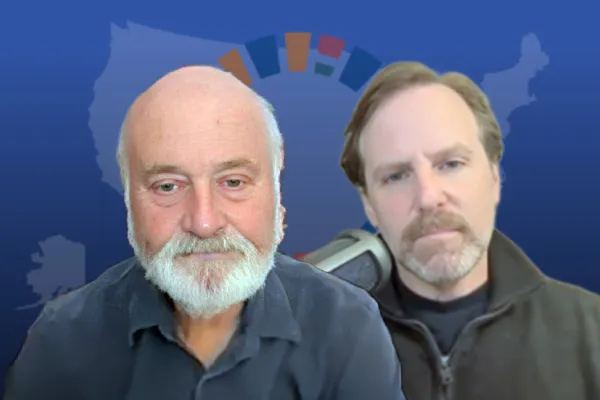
The intertwining of religious dogma with political power not only undermines the fundamental principles of separation of government and religion, but also poses a grave risk to American democracy. Recognizing the urgency to address this growing concern, legendary actor, director and producer Rob Reiner has teamed up with director Dan Partland to create “God & Country,” a groundbreaking new documentary film on the rise and dire threat of Christian nationalism to Christianity itself. This week on The State of Belief, Interfaith Alliance’s weekly radio program and podcast, host Rev. Paul Brandeis Raushenbush sits down with Rob and Dan for a special episode to discuss how the film can serve as a vital tool to safeguard democratic ideals in the face of evolving Christian nationalist threats.
“I didn't really even know about the term ‘Christian nationalism.’ What I did know was that there was a movement, a political movement, designed to do whatever it took to get certain ideas and certain policies across, and I knew it was very powerful in the Christian community – but I didn't know the term Christian nationalism. I knew there was a strong political movement; I didn't realize how strong and how organized it was.” - Rob Reiner, Emmy award-winning actor and director; producer of “God & Country.”
“I think the first challenge for the film is just for people to understand what Christian nationalism is, what those terms mean, because at first glance, they both sound like very nice things to be: to be a real patriot, you know, to believe in your country and to believe in your faith. Those don't seem like bad things. So the first goal of the film really has to be to define it.” - Dan Partland, Emmy award-winning director of “God & Country.” His other films include “#UNFIT. The Psychology of Donald Trump.”
“God & Country” opens in theaters nationwide on Friday, February 16, 2024.
Transcript
REV. PAUL BRANDEIS RAUSHENBUSH, HOST:
Rob Reiner has been a household name since playing Archie Bunker’s son-in-law on the groundbreaking 70’s hit television series “All in the Family.” The Emmy award-winning actor and filmmaker has a long and successful career, and has been public about his deep concern for the fate of our democracy. Rob’s producer of the new documentary film, “God & Country,” scheduled for release on February 16th.
Dan Partland is an Emmy award-winning director, producer and writer, who has made his mark in documentaries and nonfiction television for over two decades. That body of work includes the 2020 film, “Unfit: The Psychology of Donald Trump.” Dan directed “God & Country,” a thorough and compelling examination of the forces in our culture that have led to widespread support for Christian nationalism, and a deep distrust in our democracy. The film features many leading and respected voices that have been heard on our show, including Sister Simone Campbell, Bishop William Barber, Reza Aslan, Rob Schenck, and of course Katherine Stewart.
Rob, Dan, welcome to The State of Belief.
ROB REINER, GUEST:
Well, thanks for having us, Paul.
DAN PARTLAND, GUEST:
Great to be here.
PAUL RAUSHENBUSH:
Listen, this is a huge project. I have watched this film. I had chills through this film. It is so important. It is so timely. And so let me start out with gratitude for what you all have put together and crafted a narrative that needs to be heard, needs to be seen, and needs to be understood by the American people. And so let me just start out by saying thank you.
ROB REINER:
Oh, thank you. That was very, very sweet of you to say.
DAN PARTLAND:
Thanks so much. I appreciate that.
PAUL RAUSHENBUSH:
Listen, it is the result of a lot of work. But let me just start by asking you, how did this project come about? This isn't necessarily something that you two are always thinking about, Christian nationalism, and how it's been a threat in our country. How did you decide: you know what, we need to tell that story?
ROB REINER:
Yeah, well, first to say that I didn't really even know about the term “Christian nationalism.” What I did know was that there was a movement, a political movement, designed to do whatever it took to get certain ideas and certain policies across, and I knew it was very powerful in the Christian community - but I didn't know the term Christian nationalism.
I was approached by a fellow named Steve Okun, who used to run the the Christian outreach for Sony and oversaw a number of productions that were aimed at the Christian community. He optioned a book called The Power Worshippers by Katherine Stewart.
PAUL RAUSHENBUSH:
Katherine Stewart has been on this show, a wonderful and amazing storyteller herself.
ROB REINER:
Yeah, and so he sent me the book, I read it, and it was an eye-opener because, like I said, I knew there was a strong political movement; I didn't realize how strong and how organized it was. And talked about wanting to do a documentary, and I approached Dan, Dan Partland, because I knew Dan, I knew his work. He'd done great work, and I asked him if he if this is something he wanted to tackle. And he jumped in. And I think we all learned a lot as we went through the process of putting this film together.
PAUL RAUSHENBUSH:
Dan, you have done other films that have been about Donald Trump and other types of telling this story that people need to hear. When this came across your desk, were you like, oh, I know all about that, let me jump in - or was this also something that you were learning about as you were approaching this project?
DAN PARTLAND:
Yeah, well, I definitely came to it from the standpoint of being very concerned about the state of American democracy. I think I was, like a lot of people, I was passingly familiar with the rise of the religious right going back to 80s-era stuff, but I certainly had no idea the size and scope of what it had grown to in the intervening time. I think that that's partly a result of our media silos that we're all in. It's very possible if you're just not tuned in that you could miss it. Christian media has grown enormously and become its own ecosystem that’s got a tremendous overlap with political right in America.
Katherine's book was a starting point. But, you know, that's reporting. That's great reporting on the situation, but I wanted to get more inside. And so I think the deeper we got into it, the more we realized that even though I was coming at it from the standpoint of the threat it represents to American democracy, what the truly devout were feeling was the threat that it represents to Christianity and the American Church.
PAUL RAUSHENBUSH:
Yeah, yeah. What I want to also commend is just the great scope and breadth of people who you got to speak to, which include people who have been more like Bishop Barber, who does wonderful work. And I've been a colleague and a supporter of his; but also people like David French who come out of that community, and also Russell Moore. These people who very much were part of the evangelical community, intellectual firepower of the evangelical community, that are looking around in utter dismay. And I think that's a really important point you bring out in this film, is that some of the people who feel most dismay at this are actually committed Christians - that this film gives voice to that.
Rob, when you heard them talk, was that a moment where you were like, oh, you know what, those voices need to be in here? Sometimes this is pitted like: secular people versus Christian people - and that is completely the false narrative.
ROB REINER:
No, it was very important to have those people and those voices, because as you say, they are respected conservative Christian leaders, Christian thinkers, and they talked about not just the danger that Christian nationalism poses to democracy, but to Christianity itself. They were frightened that this rise of Christian nationalism could actually be damaging to Christianity. And so it was important to have these very conservative thinkers express that.
And you know, we were very mindful of the fact that we are not attacking Christianity in any way; what we're doing is saying that the voices that speak for Christian nationalism are not really espousing, in these very conservative Christians’ minds, the teachings of Jesus.
PAUL RAUSHENBUSH:
I think one of the really important contributions of Katherine Stewart and all of the folks is that: don't consider this a religious movement. This is a political movement, and it's a quest for power and it's a quest for control. I'm an ordained Baptist minister, and what they're suggesting is a Christian nation - is the opposite of what I understand to be Christianity. So what they’re really talking about is this thin slice of Christianity that they want to impose on the rest of the population.
At Interfaith Alliance, our tagline is “achieving democracy together.” We view, actually, the pluralism of religious power in America as a great asset for democracy, whereas you really point this out wonderfully about the threat to democracy itself that this movement holds, which I think was articulated so well. Someone said, if it comes up against their understanding of their belief versus democracy, democracy is going down.
ROB REINER:
Right. And they will resort to violence. That’s the scary part.
PAUL RAUSHENBUSH:
Oh, we're going to get to violence. That's really an important point. But to start with, the idea of “We, the people”; the idea of “E pluribus unum,” I thought Reza Aslan did that really, really nicely. That's secondary to, “We’re gonna control it.”
Dan, when you heard these kind of talks about what people will do in order to impose their theocratic understanding of America on the rest of the people, and if democracy is a casualty - so be it… Was that a moment for you?
DAN PARTLAND:
Definitely was, and I'm glad you're pointing it out. I know your listeners probably know this already, but we should take a step back. I think the first challenge for the film is just for people to understand what Christian nationalism is, what those terms mean. Because at first glance, they both sound like very nice things to be: to be a real patriot, you know, to believe in your country and to believe in your faith. Those don't seem like bad things. So the first goal of the film really has to be to define it.
And what nationalism is, and without going too far down that road, but nationalism is an inversion of a usual democratic idea - because it puts the State first. The State is the source of power. Where in the United States, we believe in democracy, which is: the people are the source of the power. So that's the first.
The second half is about Christianity. This is not a faith. You know, this is a political movement masquerading as a faith. The point that you're talking about is unique to the United States. There are religious nationalist movements happening all over the world right now, a lot of them are Christian nationalists, an authoritarian rise that's happening around the globe. But the unique thing in the United States is that a lot of American Christians believe that the USA has an important, ordained role by God in human history. And once you believe that, the United States is important in human history, that it be Christian - then that gives tremendous authority to take it in whatever direction. So what Phil Vischer says in the film, and others do as well, is that if it's your job to hold this unique place in human history and democracy gets in the way, then democracy has to go. That's unique to the American Christian Nationalist movement.
PAUL RAUSHENBUSH:
Right. And it's tied up in this idea of: if we don't fulfill what we understand to be God's mandate, God will punish us. And so people are living with this fear. And I was in New York on 9/11. I remember listening to Jerry Falwell and Pat Robertson saying it was the abortionists and the homosexuals that were the reason for 9/11. And that's when I was just like, what is happening here? And this is part of the reason that they get so exercised about imposing their understanding of what God's providence is based on, which is their understanding of a Christian nation. And I like to say, I'm a patriot, I'm a faithful man.
All the people you talk to in that documentary have deep roots in the faith. That's the amazing thing: Jamar Tisby, all of these people... Jamar Tisby also, let's talk about that for a second. Because the racial undertones, that history, is something that's really important that you bring out as part of the narrative. What's the history of this movement? How do we look back at the Ku Klux Klan? How do we look even further back? But definitely the Ku Klux Klan through the segregationist movement into the 70s, 80s of the Moral Majority and the Roe v. Wade into today. You do that beautifully. And a lot of people - Randall Ballmer, who's a great historian, talked about this as well, the connection between the rise of the religious right and racism and segregationist ideology.
Was that news to you, Rob? Was that something that you were aware of, that kind of nexus of badness?
ROB REINER:
Well, I was aware that racism was adopted as a way of galvanizing, or at least an attempt to galvanize, the Christian right. What I was not aware is that they failed. Basically, what happened is, you had Brown v. The Board of Education, 1954, and the South and the segregationists and the racist elements in our country didn't really accept that. They didn't like that idea. So they rebelled against it. They created schools that were segregated, that were based on religion, where they could segregate the population out.
But what they realized is that this was kind of ugly, and that they couldn't really galvanize a political movement around racism. It wasn't really tenable, you know? So it wasn't until Roe v. Wade in 1972-73 that they found an issue that they could rally around. And that's what gave the strength and the birth to what we see as the Christian nationalist movement now. That was an eye opener for me. I didn't realize that the initial organizing issue was race.
PAUL RAUSHENBUSH:
And you do a really interesting thing with the timeline. I'm on fire about this film, and so I really looked at it. The timeline, I think Jerry Falwell first talked about abortion in ‘78. It wasn't like they had been talking about this the whole time. In fact, a lot of conservative Christians… The Southern Baptist Church did an amicus brief for Roe v. Wade because they believed in freedom of decisions to rest in the conscience of the person. And then they switched and they were like, oh wait, we're going to capitalize on this. So just the timeline that you offer was really, really helpful.
But what's interesting is, you guys wrapped this before the president started talking about poisoning of the bloodline and these kinds of things. But there's a really important theme here, the playing on fear and anger. And I think Rob Schenck got into that a lot. Talk what that means - and how you two understand this, because you're storytellers and you understand what it means to create a moment and they have capitalized on the ideas of fear and anger.
Dan, tell me about what that feels like as someone who knows how to make films, who knows how to put that across. When you hear someone saying: everything has to have fear and anger in it, what does that mean to you as someone who really understands narrative?
DAN PARTLAND:
Well, listen, of course, you're telling a story, you want people to understand the stakes. And I think the question in any story, if you're talking about nonfiction, is whether the stakes are fair, whether the stakes are honest and accurate, or whether the stakes are trumped up. And I think that we'll take a silly one in a sense: the “War on Christmas.” The war on Christmas was: Christians are under attack in the United States!
And Doug Padgett, who is one of the speakers in the film, makes a great point that there is an ongoing narrative all the time in Christian nationalism that Christianity is the dominant default religion in the United States - and Christians can't get a break in the United States. So this is the conundrum of it, and I think some great insights are shared in the film about the ways in which the persecution complex fits comfortably in Christianity because of its own history and because of the nature of the Bible story about Christians being persecuted. It rhymes with what Christians are about, and so it seems to almost validate people's faith if they feel that their faith is persecuted. But the truth is, Christians are not persecuted in the United States, not in any way whatsoever.
PAUL RAUSHENBUSH:
David French makes that great point. He's like, it has never been stronger, the jurisprudence, on freedom of religion. And that's true. So just think about Creative 303. It was a freedom of expression case, but now we have Christians who feel very comfortable with their right to not serve gay people because it's against… I mean, all of these things that they say are being taken away from them, in fact, are being reinforced and expanded. And that was just a great intervention by David French.
DAN PARTLAND:
But I want to be fair to this idea that I do think that for a lot of American Christians, there is a sense of being embattled on some level, and I think that we, really, all, as a society, have to wrestle with that. I suspect this is coming from the secularization of society. The United States is secularizing; most of the world is secularizing. Despite, that despite that - maybe it's down 10 or 15 points across the past 30 years, the number of Americans who self-identify as Christians - but still well above 50% of the country self-identifies as Christian.
ROB REINER:
Yeah. Paul, you brought up the idea of ginning up fear and anger and creating anger, and that is a galvanizing and motivating tool for any kind of political change. The problem is that when that fear and anger turns to violence, then you're no longer in a political debate, you're in a war and people actually can get killed. And we saw what happened on January 6th: that if you're willing to resort to violence to get your way, then that is not only the end of American democracy, but, in the thinking of the religious leaders that we have in the film, it is tremendously damaging to Christianity itself, because the teachings of Jesus tell us to love thy neighbor and to do unto others as you would have it done unto yourself. And certainly you don't force people at the point of a gun or in any kind of violent way to come around to your way of thinking. So this is at the core of what Christian nationalism is.
PAUL RAUSHENBUSH:
There's been some really interesting, terrifying polling about that, that those who identify or adhere to Christian nationalism are something like seven to eight times more likely to agree with the statement: it's okay to use violence to save your democracy. And in part - and you talk about this again in your great film, God and Country - that the idea of the spiritual warfare. And when you have spiritual warfare as a guiding principle in your body politic, then there's very little room for compromise. Because it's either you win or you lose. And either Jesus prevails or Satan prevails, according to your understanding of who those people are. And so you can't compromise. Whereas democracy is entirely about compromise, and not everybody can get their own way.
ROB REINER:
I would suggest that Satan is prevailing when people resort to violence. That Jesus prevails when we love our neighbor and try to convince them of our ideas.
PAUL RAUSHENBUSH:
You know what? I would agree completely. It does invite a question, which is, where are you guys personally, as much as you want to talk about it? I have skin in the game, in part, because I'm a Baptist minister and I've dedicated a lot of my life to religion. How do you all understand, not just the democracy part, but for you as individuals? And as, well, I don't know what your faith background is.
DAN PARTLAND:
No, we can get into that, but I wanted to pick up on your last point before we lost the opportunity. I think that you actually are touching on something that's really huge and important to this polarized moment in American politics, which is that a healthy society wins political battles by persuasion. Various different political points of view are out there, but people across the spectrum are giving up on the idea of persuasion.
The specific wrinkle that pertains to Christian nationalism is that it becomes much, much easier to shut down a discussion or your obligation to try to convince anyone of your point of view, if you're going to say that this is God's will. And so when you look through history at any times that things have been sort of sold as political movements as God's will, they tend to be - I hate to say this, they tend to be some of the most evil things, because they don't attempt to justify themselves with logic or reason. They aren't making an argument to a civic society. So yes, slavery was justified, at one point, as God's will. The fascist movements; the Third Reich used a lot of God's will talk. Segregation continued to be thought of as God's will. Vile, vile things can happen when you give up the idea that you should try to convince people with reason and logic of your point of view.
PAUL RAUSHENBUSH:
Right. And religion itself cannot be the sine qua non of that argument, because religion has been the cause of so much evil. And anyone who is willing to look critically at the history of the world understands that. And so when we're talking about religion and we're talking about freedom, like, whose religion and whose freedom? are important questions to be asking.
I’m happy for you all to skirt this question about how you…
ROB REINER:
No no no, I don't think we should skirt this, because you know, I was raised in a Jewish household, a secular Jewish household. We were not religious. And at a point in my life where I went through a very, very tough time, a dark time of the soul, as they say, I reached out to all - looked and read and studied as much as I can with all religions. I looked at Buddhism, I looked at Christianity, I looked at Islam, I looked at Judaism, I looked at all of it - and what I came away with was that there was a unifying idea amongst all of these religions, which is the idea that Jesus put forward, which is: do unto others; that love thy neighbor; peace, love, spread these things. And I came away thinking this is what's important to me.
And, now, the fact that Jesus was a Jew is not relevant to me as much as what he taught, what he preached, which is: do unto others as you would have them do unto you. My father once told me, he said, if we could all adopt that, we wouldn't need Ten Commandments, we wouldn't need laws. If we all really adhered to that, we would be a better world. And so that's what I believe. I believe in those teachings. I read, you know, the Sermon on the Mount. There's wonderful things in there, but there's wonderful things in all religions when you look at them.
And you said something early on, you said, E Pluribus Unum. That's what America is about. It's about taking all these different ideas: out of the many, one. We all come up out of this and we all come together. And we have to be that example, that shining city on the hill to the rest of the world. If we are going to come together as a world, as realizing that we all inhabit the same planet, that we're all human beings, that we're all interconnected - then the idea, the idea of democracy is the way in which we can come to that. And we have to preserve democracy in order to be able to spread that idea. But we don't do it at a point of a gun. It doesn't work. It doesn't work at the point of a gun.
PAUL RAUSHENBUSH:
Rabbi Reiner, thank you for that.
ROB REINER:
Rabbi, whatever you want to call me.
PAUL RAUSHENBUSH:
You just got ordained.
ROB REINER:
It's true. It's absolutely true.
PAUL RAUSHENBUSH:
No, no, no, a thousand percent. And of course that sentiment is very, very enmeshed and embedded in Judaism. You can find it, as you mentioned, in all of our traditions.
And Dan, I want to get to your personal… But I want to just comment for a second, because another thing in this great film is that you get into: the great contribution of America is not a Christian nation; it's the fact that we actually had a nation that welcomed all religions at its founding! And it was in there. The only thing in the Constitution is that there shall be no religious test. And we did even more: non-establishment clause; freedom of exercise. This is the genius of America; it's one of the best things we did at the founding. There were a lot of things that we did that were not so good; this was the best thing we did. And for people to take that away from us and say, actually, it was meant to be just one group who had dominance over everyone, and fall in - it's a terrible!
ROB REINER:
And it’s also saying - we have it in the film - there are a number of Christian nationalists who say, there is no separation of Church and State. That's just not true. It's not true! It's three times in the Constitution. So just to say things like that is very divisive.
PAUL RAUSHENBUSH:
It's a disinformation campaign. I give talks around the country, and people threaten - because they're very invested in it.
DAN PARTLAND:
Listen, this is the United States' greatest contribution to the world. The world is pluralistic. All countries are pluralistic, but we were really the first to separate Church and State. And you do this to protect religious liberty. We get very, very upset when we hear about other countries, going down a religious nationalist road: oh, there's Sharia laws being imposed and stuff like that. We don't see it when it’s being advocated right here at home.
But you know, down to the very founding, there's all kinds of questions about whether the founders knew this or thought this because many of them were Christian, most of them were Christian. Look, Washington says it. He says it. This is our contribution to the world worthy of imitation. And then it has been imitated. It's been imitated all over the world, such that in my very multicultural, pluralistic family - an in-law who is from a majority Muslim country, they talk about the central debate in that country right now is between the party that believes in the separation of Mosque and State, and that doesn't. And you know, the way that expression, the separation of Mosque and State, rolled off her tongue - this is an American idea that is now all over the world, because we've recognized that in order to have true religious freedom, you need a secular government. It's inspiring.
And then I'll use that to segue into my… I have a great interfaith story. We didn't really think about, when we were looking at starting the film, weren't thinking about what… I was thinking about American democracy and journalism and things like that. I wasn't really thinking about how it played in with me personally, but I have multiple generations of interfaith marriage in my family. And so what that meant, in the short term for my parents, was that there was some friction for them getting married. They were of different faiths. And so they really decided that they didn't want the divisiveness part of that. They wanted to teach the kids about spirituality, about the different religions, and not that it was important to hold on to a specific identity as any one of those, but that you were welcome to choose one when you came of age.
And so among my first cousins, we have Catholics, Presbyterians, Jews, Atheists, and Greek Orthodox. None of my first cousins has the same faith as any of the others. That's a true American story. So in my parents' generation, there was still some friction about it, but by the time of my generation, we all happily went to each other's services and celebrated in each other's manners. When we were at this family's, we wore yarmulkes. When we were at this family's, we knelt. And so that's always how it's been for me. And so when I hear people saying that there's something un-American about that, or that certain families out of my five cousins are more American, are more entitled to the legacy of America, I think that's just, I think it's foolish and I think it’s ugly.
PAUL RAUSHENBUSH:
I really appreciate you saying that. And the listeners of this show know, Louis Brandeis, the Supreme Court Justice, was a great-grandfather of mine. And then you have Christians on the other side, and my grandparents were in interfaith marriage. My closest cousins are my Jewish cousins. And if you try to say to me that my Jewish cousins have a secondary place in this country, don't try it - because we're not having it, and we're not having it.
The other thing that's really important that you talk about, and I so appreciate it: this is an unpopular movement that is using political levers to impose unpopular ideas on the public. And we have to emphasize that. This is not representing… The majority of the public supports the right of women to have reproductive freedom; the majority of the public - and religious people - support the right of marriage equality and the equality of LGBTQ people, and on and on and on. And the rights of immigrants to have a decent... There's lots of things. We have to remember, they don't represent the majority, but they are often very loud. That is the reason it's so important for people like yourselves with your microphones to be speaking into this. It matters.
If you could create an audience for this film - who you really want to see it - what would they look like?
ROB REINER:
Well, first of all, everyone. I mean, it cuts across all demographics; but particularly amongst Christians who are not fully aware of the danger of Christian nationalism. We're talking about devout Christians, we're talking to church groups that, hopefully, will share this with their friends to get them to understand what this is: that this is not an attack on Christianity, that Christian nationalism is an attack on Christianity. And so that's what we're trying to do, is to try to get people to understand what Christian nationalism is.
And you said something very important, which is: it's a smaller subset of the Christian community, but it's vocal and it's strong. And even that minority can overtake the majority if we're not careful. And that's where we are right now in America.
PAUL RAUSHENBUSH:
Yeah, there was a lot in the film about that - what it means for a minority to be totally activated and inspired by anger and fear to go vote, to go show up. It's a powerful kind of wake-up call, hopefully.
The other piece that I'll just mention, self-serving a little bit, but the amount of money that has been put into this movement. When people like me, I'm the president of a scrappy organization, and we're like, please give us a little money. We are being outspent millions to one on this. And it's important because religion really matters. And so those of us who are in the religion sphere trying to put forth another point of view and offer an alternative for how religion can play into American society, and we see the - there's a chart that I literally, I rewound it and I took a screenshot and I was like, that chart of the money that's been going into this movement resulting in billions of dollars. It's not accidental that they've been successful on many of their issues.
One of the things I just want to make sure that we spend a little time on is all of the footage of January 6th. I thought I had seen every B-roll of January 6th. I had not - because I had not seen them do that prayer from the podium in Congress.
Having desecrated, broken windows and hurt people, and, potentially, by that time, killed people in their rampage. And there they are, praising God and blessing their thing. It is so heartbreaking, I have to say, in some ways for me as an American and as a Christian, to see religion and America desecrated in that way.
DAN PARTLAND:
Yeah. Yeah. Just a kind of craft note about that: it was very important. One of the things in that sequence is, that the sequence really starts with seeing multiple prayers, including the prayer of the Senate chaplain. And that was really important to me, because obviously the legacy of Christianity is all over the culture. Nobody's trying to deny that and nobody is trying to stop that. There's the Establishment Clause, but there’s the Free Exercise Clause. But you see how different, even some of the same words, what a different character they can have, depending on where you're going with them, what your true intention behind them is.
PAUL RAUSHENBUSH:
Yeah, let me just say, that is incredible filmmaking, because there's images of Chaplain Barry Black, who is the chaplain of the Congress, saying, today we have a sacred duty to… I'm not going to say it exactly right, and he's trying, too, that we fulfill our duty to democracy and you know can certify the election.
DAN PARTLAND:
The sequence begins with his prayer, Paula White's prayer at the Ellipse before Trump speaks, and the third prayer is the Proud Boys in front of the Capitol - all of them roughly simultaneously. Slightly different words, but vastly different intentions.
PAUL RAUSHENBUSH:
And even before that, the Jericho marches, which I have been aware of and I've seen some footage of, but the chronology of, this is what they were going for. The Jericho march is for the walls to come crumbling down, and then you see it happening.
Listen, where do we go from here? As citizens of America, what would you hope would be a documentary you could make in four years' time? If you could wave your magic wand and things would happen, that you could tell a different story in four years, what do you see as the things that need to happen right now?
ROB REINER:
Well, I'd like to tell a story that says that the decent and good side of people wins out. That when we put these forces together and they butt heads, that good prevails over evil and that we're moving towards that more perfect union that we laid down, those markers that we laid down for ourselves at the beginning, that we are actually moving towards a more perfect union. Now, you can say fits and starts, two steps forward, one step back and all of that. But if we don't stay on the path of respecting our democracy, the rule of law, and all our institutions, and we tear it all down, as we've heard, the deconstruction of the administrative state. If we do that, and the world starts turning towards something else, that would be a disaster. So I’m hoping that we could make a film that shows that we are moving to a more perfect union.
DAN PARTLAND:
Yeah, I think we're in the middle of a great reckoning in the United States right now on a lot of different fronts. I think it's important. It was overdue. It's necessary. Reckoning on race, on sexual assault, on income inequality, down the line. The environment. Down the line, we're trying to take responsibility. And the result in the short term, I think, has been that American institutions have taken a hit. People are having a hard time believing in them. And when they have a hard time believing in them, they have a hard time believing in us. And when a society loses faith in who they are, things come off the rails.
And so my concern at the moment is that in our effort to tell the true story of all the ways in which we fell short of our aspirations over the years, that we're losing our sense of what is really great about America. And it really is great about America. We do pluralism better than anyone in the world. We do opportunity better than anyone in the world. Down the line, we do equal protections under the law better than anyone in the world. We're losing that. We're losing that, and it's heartbreaking. I do believe in Americans and an American character that ultimately prevailing decency will come through and we will reconnect.
But the film I want to see in four years’ time or whatever it is, is all about the ways in which Americans are reconnecting with what it really means to be American - and I'm not the guy to say - we should have bona fide Christian leaders are the ones to say it - but there's a similar reconnecting that I think needs to happen on the side of American Christianity. Because it's really hard, when I look at the political deliverables the Christian nationalist movement is looking for right now, a movement that overwhelmingly supports the idea of preemptive war, that has been for the death penalty, that has been against gun safety, gun regulation, that has been against protecting the environment. Down the line, it's really hard for me to see in that list of deliverables - the hostility towards immigration - it's really hard for me to see how that's about doing unto others or turning the other cheek or loving your enemies.
So one of the great hidden blessings, for me, of this film is that I really immersed myself in a lot of Christian thinking, Christian ideas, and kind of reconnected myself with what they were about. Because so much of what they've become about in the forefront of my mind is about these political deliverables that I think just don't have anything to do with the faith at all.
ROB REINER:
And if you look at the end of the film, it is hopeful. What Barber says at the end of the film is very hopeful. He talks about reinstituting these basic ideas of Christianity, and if we are able to do that, what a wonderful world, what a wonderful country we will be.
PAUL RAUSHENBUSH:
Right. Well, I loved that part of the film. It was so, you know, literally chills, because you had just been through all this, but there wasn't just about what we can do going forward, as a reminder that, actually, Christians have done really good things and they can do great things. Hospitals; caring for the poor; being out there…
ROB REINER:
Education…
PAUL RAUSHENBUSH:
There's lots of work to be done and there's a great tradition in America – literally, the Martin Luther King, Jr. tradition of American Christianity is another example to the world. And so, if we can lean into that, as Christians, I'll say for myself, but also as an American that really believes in like, we can do better. And not looking backwards - that's part of this. The reason Donald Trump has been so successful, Make America Great Again, Christian nation, back, look back, and creating a different narrative about what that was that is falsified.
Instead, looking forward how we can continue to build e pluribus unum and how we can love one another. I love that that was the way you ended the film. It was hopeful. You woke us up and then you gave us a path forward. I want to end just by saying thank you again. A little gratitude sandwich for you guys, but you know, this is a lot of work. It meant so much to us who are out there really trying to make this happen, to have people of your stature pay attention to it, tell the story, and give us an asset, a tool that we can share. So, thank you to Rob, and thank you to Dan for being with me on The State of Belief and for all your work on this great film, God and Country.
ROB REINER:
Thanks so much for having us, Paul.
DAN PARTLAND:
Fantastic, Paul. It's been great to be with you. I do want to say, I love your last point and want to just say that, also, a huge part of why we made the film - this stuff is so, so hard to talk about. And we hope that it's a tool – exactly! You can't broach this stuff at Thanksgiving dinner, it's too complicated. But that maybe people can say hey, will you watch this for me and tell me what your thoughts are? Maybe that's a way to open the door to a really important conversation that I hope we're all having.
PAUL RAUSHENBUSH:
I really hope that happens. Everyone has got to be listening and learning and growing from watching this great film, God and Country. Again, thank you both so much.
ROB REINER:
Thank you.
DAN PARTLAND:
Thank you.

Congressman Jared Huffman: The Fight to Save Democracy From Christian Nationalism
The co-founder of the Congressional Freethought Caucus joins host Rev. Paul Brandeis Raushenbush to discuss how he's seen authoritarian impulses show up in our government and to share some of the insider stories featured in his best-selling new book, "No Prophets"