State of Belief
Voting is a Sabotage Disrupter: No Kings IV With Indivisible’s Leah Greenberg

Five million. Seven million. Eight million. That’s how participation in the No Kings movement has grown – and on October 17th, it’s time for the biggest yet, No Kings: Vote Early, with the focus on ensuring every eligible voter casts their ballot, and can do so safely. This week, host Rev. Paul Brandeis Raushenbush talks with Indivisible co-founder Leah Greenberg about community organizing, voter participation, and the power of neighbors coming together. It’s a hope-filled conversation about defeating authoritarianism and expressing love for our democracy – and for each other.
Leah Greenberg is co-founder and co-executive director of Indivisble and catalyst for the nationwide No Kings initiatives. Her book, written with her husband Ezra Levin, is titled We Are Indivisible: A Blueprint for Democracy After Trump, and you can hear Leah and Ezra on Indivisible’s “What’s the Plan” podcast.
Transcript
REV. PAUL BRANDEIS RAUSHENBUSH, HOST:
Leah Greenberg is co-founder and co-executive director of Indivisible, a grassroots network of local groups resisting manufactured conflicts among sincere and passionate people, and coming together in defense of our democracy, diversity, and shared future. Leah has been instrumental in launching the unprecedented No Kings initiative, which brought many millions into the streets of America and beyond in opposition to the authoritarian leanings of this administration. Her organization has led to the minting of first time activists, the formation of powerful new networks, and hope-filled commitment, as opposed to overwhelm and fear.
With a critically important election-focused No King's Day of Action coming on October 17th - and we're going to say that many times - and the partnership between Interfaith Alliance and Indivisible growing ever deeper, I am so happy to have Leah Greenberg back on the show.
Welcome, Leah.
LEAH GREENBERG:
So great to be here.
PAUL RAUSHENBUSH:
Leah, how are you feeling? I I just feel like I have to ask people like you, how you doing in this day? We're a month out from the midterms. There's so much going on. Are you feeling energized? Are you feeling hopeful? Are you feeling overwhelmed? What's your feeling?
LEAH GREENBERG:
Is all of the above an answer? You know, I think, like anybody who's been living through the last few years, is going to alternate between the moments of hope and energy and just pure rage at what is happening. And sorrow. And also, I'm just right now in the mix with so many people who are working so incredibly hard to turn things around and that just keeps me moving forward. It really does.
PAUL RAUSHENBUSH:
It's amazing. And you know, it's been a ride, hasn't it? I mean, we really, two years ago or or however long, more like eighteen months I guess, we started a very serious time in our country where it felt like we just weren't sure what was happening, and it all felt like it was happening so fast and and there was a sense, a manufactured sense of inevitability of what was happening.
And into that mix, all of a sudden you started seeing, like, okay, there was a Hands Off! event, and then there was something called No Kings. Let's have a conversation about what is that going to be. And behind all of this, Indivisible just decided, okay, we're going to use our networks and we're going to help people turn out and reverse that sense of inevitability of an authoritarian takeover, and say, actually, We the People are still going to matter and we're going to insist on it. So that is really important work that you all have been doing in collaboration with so many other groups.
LEAH GREENBERG:
That's right. And you know, I think that's exactly the right analysis of where we were and how we got there. We didn't enter 2025 expecting that we were necessarily going to be big mass mobilization people. That hadn't necessarily been the role that we primarily played in the past. And also, you know, American society was in a dark, dark place - and more so, even, than I think a lot of us expected. I didn't have high hopes for a lot of America's elites, but I was nonetheless still surprised by the speed and the depth of the collapse amongst a lot of elite institutions, a lot of political leaders, a lot of media and corporate and rich, wealthy people, just how fast people moved to to sort of assume that this was the new order and that you had to get in line and you had to find your place in it, and resistance was futile.
And sothe mass mobilization strategy that started under Hands Off! and expanded into No Kings, it wasn't about one specific policy demand or one specific target. We were realistic about the fact we were not going to convince Donald Trump to behave differently, but it was aimed at everyone across American society who seemed to have lost their will, who was folding in, who was complying in one way or another with this as if it was an inevitable consolidation of power.
PAUL RAUSHENBUSH:
I just remember I was down in Florida, in Sarasota, and I was I was going to preach at a a Unitarian congregation - and the day before was Hands Off! And I was just like, okay, let me go down there and I'm going to be one of like twenty-five people and people are going to be throwing apples at us and expecting the grim realness of what was happening.
And instead there were just thousands and thousands of people and everybody was looking around saying, wait, none of this is fixed. In fact, they said, we've never seen anything like this in Sarasota. And I think all of a sudden something sparked, something changed. And the next day I went through, I'd listed all the bad things that had happened in just the first four months. And then I talked about what had happened at Hands Off! and what I had seen and the signs and you could see that people needed to have it named, that they weren't insane; that things had been bad, but also that, yeah.
And the big joke that's been following like Hands Off!, but then No Kings, all the No Kings, was that someone was paying for all these signs. And I was like, listen, no one's paying for all these handmade signs that are so different. So it's been just incredible. And you know, one of the great joys and privileges, I think, for me and for Interfaith Alliance, but also for faith communities all over the country, very diverse, was an explicit welcome that Indivisible, that Move On, that all of the kind of No Kings organizers really made clear: Actually, faith is a part of this movement. We're going to take away that God is for the authoritarians, and actually talk about how democracy works when all are welcome. And you all did that really explicitly. And I just want to say thank you for that, because it's been a really important part of this moment and what we've been seeing.
LEAH GREENBERG:
Well thank you for being part of it because it really required people who were willing to jump in and step forward and organize other people and make it possible for us to really adopt more of a big tent strategy. And it was very much a kind of core theory of the case that what we were doing was not working, and we needed to figure out ways that we invited people in who don't necessarily always feel totally welcome in the classic progressive only mold.
A lot of the thinking behind both Hands Off! And No Kings was, we want this to be something that's legible to people who don't already come to the big progressive marches. We want it to reach people. We want to bring everything that's animating us as progressives, but we want to reach people, we want to reach veterans, we want to reach folks who are not political, who would never identify with a political party. We want to reach people who maybe don't see their faith represented normally in some of these gatherings. That was very much part of the strategy, and we're just really grateful that we've had partners who helped us make it possible.
PAUL RAUSHENBUSH:
Yeah, just naming that and saying: Actually, you are welcome here. There was a line that someone said, when I was talking to various organizers, that just being really honest, we've been a little bit allergic to religion because we're worried it will be divisive. But it doesn't have to be framed that way. I mean, people are going to come with what they're going to come with, but if you can see everybody there, it shows, actually, the possibility for democracy. And so you're actually embodying a future vision. Even if you don't agree on everything, you agree that we want this democracy to survive.
And that's really been an important throughline, I think, of No Kings and also of Interfaith Alliance. Just like, listen, we may not agree on everything, whether it's the Middle East conflict or something in the South Asia diaspora or even in this country, we may not agree on every single thing. But we do respect the idea of a democracy's thriving. And that has been so important.
So I want to turn - just to make sure that we get to it and go deep with it - we've gone through what No Kings One... We didn't even call it No Kings One, we just called it No Kings.
LEAH GREENBERG:
We did not know it was going to have sequels.
PAUL RAUSHENBUSH:
And then we had No Kings - we didn't know we were going to do it - then No Kings 2, and then No Kings 3. Each time more and more and more people. And one of the coolest things, it's just worth spending a minute on, is it wasn't just the New York No Kings got bigger. It was actually expanding the map of where No Kings was thriving in small towns, in rural areas, in places where… That was really the thrilling part. And it wasn't a blue state phenomenon. It was an all-state phenomenon. And that was really incredible - including all around the world, frankly.
Because there was one question that was like, is Guam on board? Is Guam on board? Are they online yet? So all that good stuff. But now we're at, I think it's No Kings 4, but really, No Kings that is focused on the early vote. Because it was never just about showing up… At the beginning, it was important to show up because people needed that. Now people actually are looking for a catalyst towards the election. And talk to me about October 17th and what the significance of that day is for No Kings.
LEAH GREENBERG:
Absolutely. As you said, I think we see this as a really exciting evolution of the No Kings movement. The first three protests were fundamentally really about halting that authoritarian freefall. We were in this period where American society was deciding who we were going to be, and everyone across American society was making decisions about: How much am I folding in and how much am I resisting? And they were all kind of looking left and looking right to figure out: If I do this, whose company am I going to be in and how much pushback am I going to get?
And there are a thousand ways that we collectively marshalled pressure on various people to make better decisions. Everything from the Disney Kimmel boycott to the No Kings protest to local organizing to push back on ICE and get businesses on board, all that. But it was all fundamentally about making sure that we could preserve the conditions for the core functions of democratic governance, which is to say a free and fair election. And so it was very much a natural shift to us to say, how does the No Kings movement pivot to protecting this election? Pivot to ensuring that this is as much of a free and fair election as we can make it, with all the caveats about free and fair elections within American history and the many ways in which voter suppression has always been with us.
And so No Kings Vote Early was really birthed out of that. It was this core intervention that was saying: Let's turn the protest power into voter power. Let's ask for people to think not just about how do we get the biggest turnout, but how do we get the biggest early vote turnout in American history?
And that's for a really specific strategic reason, because when you have a would-be authoritarian who's attacking the process of voting, the process of counting, the process of certifying, one of the most important interventions is overwhelming turnout early in the process in such a way where if there are problems, they can be identified and addressed early. If there are authoritarian attempts to disrupt, we can understand and see where they are and mobilize and plan around them. And we can create this kind of confident, enthusiastic, joyful, defiant vibe around voting that helps us to carry through the disinformation and the fear and the disruption that they are planning to spread.
PAUL RAUSHENBUSH:
You said something at the very beginning that I just want to spend a second on because I think it's really important. This idea of if there are any problems finding out early. So we've already seen in places like Texas where people are all of a sudden, am I on the rolls? And voting early, showing up and saying I'm here to vote and finding out, oh, is there a problem with my ballot? Is there something I can need to do? That gives you two weeks or so in order to to resolve it. But if you do it on election day, they may say, well, sorry, it's too late.
The way you said it was the first time it really sunk in. That's a really good reason to vote early. In case there's any question about your your vote, you can resolve it - because you do have a right to vote. And I think that what you're encouraging is - because there's so much out there that is meant to discourage us in order to create doubt or create confusion - we have to cut through that and say, no, there is no confusion. There is no doubt. There is an election and I'm participating. And voting early is a great way to start that.
LEAH GREENBERG:
Exactly. Exactly. It is a sabotage disruptor.
PAUL RAUSHENBUSH:
It's a sabotage disruptor. Woo! I love that phrase. That's exactly right. And I think, also, it's a mentality thing, because the more people who understand we're getting out there like No Kings, we show up, but we're also doing something specific in this case to preserve our democracy. And democracy is not only about elections, but elections are a really important part of our democracy.
You know, I've been speaking, I spoke, actually, at a Yom Kippur service at a synagogue, and and I just said, like, believe them. They have said they're going to disrupt elections. I don't want to instill fear. There's no reason to be fearful, but there's no reason not to think that there's going to be shenanigans because, you know, when Kash Patel is floating something like, well, maybe I'll send the FBI to polling sites. It's totally illegal. You can't actually do that. But they're just floating it out there in order to create drama and also intimidation. And this is one way to cut through that.
LEAH GREENBERG:
Yep, absolutely. Absolutely. It is.
PAUL RAUSHENBUSH:
I'm really excited about it. And I think that what is already happening is that there are, already, No Kings events for this on Mobilize. You can go to No Kings Vote Early. We just had a conversation because our bus tour - by the way, thank you to Indivisible who is a partner in this The Vote is Sacred Bus tour. all of our locations are going to be on Mobilize with Indivisible. It's just an incredible boost and boon to Interfaith Alliance. Thank you for that. But our bus is going to be in Charlotte, North Carolina. And we were talking to faith leaders in Charlotte and they were so excited because people are going, there's a huge movement of mobilization, outreach, door knocking.
So, again, No Kings is going to look different this year. It's not going to just be one place where we all try to show up. It's going to be all kinds of things focused on getting people to register and to vote early. So that's really exciting. Are you seeing the kind of enthusiasm that we've seen in the first three No Kings?
LEAH GREENBERG:
That's exactly right. Yeah. absolutely. And we're seeing, there’s going to be some big rallies, but there's also a ton of really cool creative hyperlocal events that are coming together. We're seeing Paws to the Polls, it's like an adoption mobile event plus voter turnout and you earn at your local election precinct. There's a lot of concerts, festivals, family friendly activities, efforts to really get people both to vote and also to do it in a way that draws out a bigger swath of the community than you might have before.
There's a lot of trainings and preparation in the event of election sabotage, a lot of connectivity happening with local election protection groups so that people who need volunteers are getting connected with the volunteers who want to take action. I think it's going to be a really big and powerful and joyful day.
PAUL RAUSHENBUSH:
I think it's great. So we're just a a couple of weeks out to No Kings Vote Early. And I think people more and more are feeling like they don't need permission to do good stuff. People know that there's nothing stopping you from showing up. So I just want to encourage everyone who's listening, make sure that the next thing you do on wherever you are is check out No Kings.
We again have some faith resources for No Kings Vote Early that we're putting together on Interfaith Alliance and our website that is VoteIsSacred.org. And I really encourage everyone, everyone, especially those of you who were excited about all the No Kings, recognize this is the next step. This is in some ways what we were building towards was showing up. And No Kings still means no kings. We still have a president who just as casually puts out whether it's an AI imagery or whatever, whether it's him as Jesus, him as the Pope. Him as a king. It's all of these positions of saying, look at me. And there is a sense that he keeps on and that he is building something for himself. Even the ballroom that he's building feels like something that a king would build for themselves. It doesn't feel like it's for us. And so we have to recognize that it's up to us, the people.
No Kings will happen October 17th. That doesn't mean Indivisible is going to stop being present. What are other ways that Indivisible is showing up in this moment?
LEAH GREENBERG:
No Kings is one part of a broader effort around election protection that we've been doing. So in all the places where we're particularly worried about sabotage attempts, voter suppression, etc., we've been preorganizing our folks in order to make sure that they're ready to be the mobilizing and the volunteering and the collective glue necessary to help secure the vote and secure the process of election.
Of course, under our Indivisible hat, we're also very much aiming to turn out the vote. And you know, all systems go on that front. But then the other thing is, we're going to go into next year and we have to plan for and move into a window where we start to talk about accountability. We start to talk about what is an affirmative vision to put forward. We start to actually lay the groundwork for the fundamentally transformative agenda that we are going to need in 2029.
Because one of the clearest things, one of the things that everybody in our movement is so aligned about, is that this is not… We might have gotten started in or people might have joined in reaction to one specific election, but this is not about going back to, you know, 2024 - because 2024 was not great, either. And so we've got to actually come get aligned collectively on what is the transformative agenda that makes people believe in democracy because they see it showing up and working for them in their lives. And then we have to go full throttle to get it.
PAUL RAUSHENBUSH:
One of the things we're thinking about is, we've been playing defense for these past two years, but what does it mean to put forth ideas and visions and policies that are actually going to move us forward and have a vision for the future; that we're not always just saying we don't like that, we don't like that, we don't like that. And there's lots to not like, but I actually think and what's so clear is building things is so much more exciting, but it also takes a lot of work. It takes a lot of work to build things. And I'm excited for all of us to be able to imagine, to get to the point where we can, what is the future that really brings more and more people into our democracy in a full and fair way with dignity? And that is something that I'm just excited for the opportunity to have my mind working in that way as opposed to fending off threats.
I don't know if you saw this, but the Varieties of Democracy, that group out of Sweden, took us off the liberal democracy list for the first time in 50 years. So it was really interesting. I had him on the show and this researcher from Sweden, and he just said we've never seen a decline so rapid, aside from a coup. And in some ways, thinking of this in terms of a coup is actually not the worst language. So what's really important in that for me was: We're not crazy that we're thinking that we have to turn this around. But it will take quite a bit for us to build, rebuild.
I want us to get back on that list of liberal democracies. I think we all do. Have you all thought about 2027? I know we have to get through this time, but what have you thought about, even if we just have a more sympathetic Congress, I know we're nonpartisan, but what are some of the things that you would love to see Indivisible get involved with in 2027?
LEAH GREENBERG:
Well, fundamentally, I think that the thing that control of the gavels gives you is the ability to start driving a message and making some progress on laying groundwork on accountability. And for us, I think there's a really powerful nexus between talking to people about cost of living and talking to people about corruption that has to be reinforced over and over and over again during this window.
Because fundamentally the story that we need to buy people into, that is part of that path to a transformative agenda, is about both the fact that your own life is getting worse and the fact that there are actual real clear explanations for why there is, in fact, an elite in Washington that is enriching themselves and seizing power in order to keep the party going while your life gets worse. And so pairing up a laser focus on genuinely wanting to improve people's lives in ways that show up in a lived experience, and accountability for the people who've ransacked the federal government, destroyed its services, filled their own pockets and shoveled benefits to their buddies and created a secret police in order to govern and instill societal control so that they can continue to keep the party going. That is a really crucial part of the priority for 2027 because we just actually have to start driving that home.
PAUL RAUSHENBUSH:
I think that that is a little bit of a scary term, accountability, but it's so important. I mean, if we think about just the way that the president has grown so much richer. I mean, I think about President Carter putting his peanut farm in escrow or whatever so that he couldn't touch it. It's a distant memory.
LEAH GREENBERG:
We're so far past that.
PAUL RAUSHENBUSH:
In crypto alone. It's just, you know, billions of dollars. So that accountability is so important because it's like, did you think that we weren't watching?
LEAH GREENBERG:
Billions. Billions. Well and I think, especially when you think about the harm, we have experienced a societal rupture that is kind of extraordinary and mind-boggling in scope. If you think about the harm that has been inflicted, for example, on our immigrant neighbors and communities and the ways in which the kind of fundamental promises about what America is supposed to be have been ripped apart over the last couple of years by an administration that is completely uninterested in the laws, actively attempting to dismantle the entire civil rights infrastructure of this country, very obviously attempting to enshrine a hierarchy in which they are at the top and the rest of us simply obey. Yes, it's accountability. It's societally lifting up what has happened and echoing it back and reflecting it.
I think the parallels that we have to look at are not just what have we done in past administrations. They're like, what have other countries done in major large scale situations where horrible crimes have been perpetuated against their people, right? You know, it's like truth and reconciliation processes. It's large scale prosecutions. It's things that actually meaningfully reinstate some kind of baseline expectations around the rule of law and order in this country.
PAUL RAUSHENBUSH:
Wow. That is so powerful. I really appreciate you naming that, and that will be hard work, but really important work. And also just reminding people: Just because you're president - and especially if you're president - doesn't mean you get to line your pockets with so much money. Or in Congress or a senator. It's really important.
I am curious how you see religion in America today? Because the last time we talked, you talked about how you were inspired by your Jewish tradition to do this work. We are in a moment of incredible rising antisemitism that is coming, there's a lot of people who want to just point at the left and say, look how antisemitic they are. But then you look at the right and there's terrible violence that's happening being named, and I'm just curious, how are you feeling within that? I know that's hard to answer. I don't mean to put you on the spot, but it's very concerning to me and to all of those us who are caring for the rise in antisemitism and the parallel rise in Islamophobia, unfortunately.
LEAH GREENBERG:
Yeah. Well gosh, do you have another hour for me to talk about that?
PAUL RAUSHENBUSH:
As long as you need.
LEAH GREENBERG:
I’ll say my thoughts. As a Jewish progressive leader, I think it's been an extraordinarily challenging time to navigate because there is a good faith conversation to be had about the rise in antisemitism in this country, the ways in which it has dramatically increased in recent years. And there is also a bad faith weaponization of antisemitism that has been extraordinarily present and has shown up in so many of the places where we try to have any conversation at all in relation particular to policy around Israel and Palestine. And you know, untangling those two things is extraordinarily hard in a lot of settings.
And certainly as somebody who's led a progressive organization, as a Jewish person, and as a movement that's got plenty of Jewish people, and that was also out for a ceasefire in Gaza very early in 2023 and for pushing for consequences around Israel during that window, we got the full force of what that bad faith antisemitism set of accusations look like, as well, including from institutions that I've been in relationship with and interacted with in the past.
You know, when we talk about societal institutions and elites that made decisions to comply or to allow themselves to be used as a pretext for intervention, one of the first ones that I think about is the Anti-Defamation League, which has historically been one of the more prominent entities that are supposed to be fighting antisemitism in the US, but has actually validated a bunch of the most alarming attacks on universities and higher education, the repression of free speech of Mahmoud Khalil and other pro-Palestine advocates.
I think we've seen some really upsetting defections from people who ostensibly – and, you know, in the first Trump administration were much more forward-leaning about defending civil rights and defending democracy as a fundamental Jewish value. And so, you know, when we talk about this period, I think there's an entire conversation about how much are our Jewish values calling us to collectively stand in defense of democracy, both because that's our value and also because Jews are safer in multiracial, pluralistic democracies, and everything we know teaches us that that's the long-term way to secure our safety? And how much are we signing on to parts of an agenda that are ultimately extraordinarily damaging to Jews in service of suppressing critiques of Israel?
PAUL RAUSHENBUSH:
It's not easy to articulate, and I think you've articulated your position very clearly. And people have to understand this is your positionality. And it's really important to honor that and to recognize that you've been watching this very carefully, and you don't take off your hat as an American Jew when you're leading Indivisible. In fact, that's actually one of the sparks that is inspiring your work. And it's really important for me to say that as someone who is a fan of yours and a fan of Indivisible, is that it's really powerful for people to be their authentic selves and not to feel like they have to cut off a part of themselves, especially the religious part of themselves, especially the religiously-inspired moral understanding of a moment. And so while not all of you, my listeners, may agree completely with what Leah has said, I think we all have to honor exactly where she is coming from. And I certainly do. So I really appreciate you saying all of that.
Let's just go back to October 17th and this moment, because October's going to be so important. Once November hits, it's the election and we can all know our, how are you going to show up, how are you going to support everyone who wants to vote, all of that; but in October, I'm just going to randomly throw out a number, three things that you would love for people to have top of mind as we go through October leading up to the November election?
LEAH GREENBERG:
My first one is always going to be the same: Get in community locally. If you are not already connected, if you don't have a political home, find one. No Kings is an excellent opportunity. Show up, find out who's putting it on, find out how you can stay in touch. But always you're going to be most effective if you are in a relationship and figuring out what your needs are and working and strategizing on your own, on a level with people in your community. So that's one.
The second is, we need to collectively tap into our power. so much of the election sabotage play is about misinformation, disinformation, fear, and making people feel powerless. And we just have to totally reject that. They are doing this because they are afraid of us, not the other way around. So tap into your power.
And the third is, hold each other up and operate in solidarity. Their other classic play is divide and conquer. That is a play that depends on us allowing them to do it.
PAUL RAUSHENBUSH:
I love that - and hold each other up. I mean in some ways that's the reason I was like, you know, how are you doing, Leah? at the very top, just acknowledging that people might be not doing so well. So maybe you can say an encouraging word or or bring them a cookie or whatever treat they like. There's lots of ways that we can show up for one another, but it's all about connection. And I think all of what you said was about connecting.
And you know, democracy is just about people. It's about us. It's about us showing up together and figuring out the best way to govern us. Us supporting one another and governing us. And so I just think it's so important. October 17th.
I'll just ask you one more question because this gets to the the vote early. If someone goes to… And I know not everywhere can you vote early. In some places it's not… Do I have that right? There are places where voting early is not possible. Let's talk about that for a second.
LEAH GREENBERG:
Yeah, absolutely. So there's a small number of states that do not have vote early at all. I think that's four states. There is another dozen plus or so that do not have vote early as of October 17th. We designed it to start, to be part of the kickoff of the majority of states in the country have early voting, but that doesn't mean it's everywhere. Amongst those, there are some places where you can drop off your ballot during this window. So I know plenty of people in Michigan, for example, are planning early vote rallies where they're going to drop off their ballots, even though the in-person voting mechanism is not available. So there's some different options based on where you are.
In places where it's not available, we're urging people to just think about what would make sense. Is that a rally where you do a training and you prepare people and you get them ready and you make sure they've got what they need to vote next week? Is it a local block party where you're doing the same and delivering the same content? It's going to be up to people to make the best decisions for their community about what makes sense. Is it a visibility event, all of the above? We're just asking folks to really strategize creatively about what is needed to give people that extra push wherever you are.
PAUL RAUSHENBUSH:
Well, I think that's the point. There's an opportunity for some of us just to go and vote early on October 17th. For all of us, it's an opportunity for us to begin to imagine how we're going to vote. If we can't do it that day, you know, make a plan. Make a plan with a friend. Figure out a way to make sure that you are prepared to vote, ensure that you are registered to vote. There's all kinds of things that you can do on October 17th to be a part of it.
Leah Greenberg is co-founder and co-executive director of Indivisible, which was a key organizer for the nationwide No Kings Days. Her book, written with her husband, Ezra Levin, is titled We Are Indivisible: A Blueprint for Democracy After Trump. And you can hear Leah and Ezra on Indivisible’s What's the Plan podcast.
Leah, it's going to be an incredibly busy couple of weeks, months, for all of us. So thank you so much for making time on the State of Belief.
LEAH GREENBERG:
Such a pleasure to be here. Thank you.
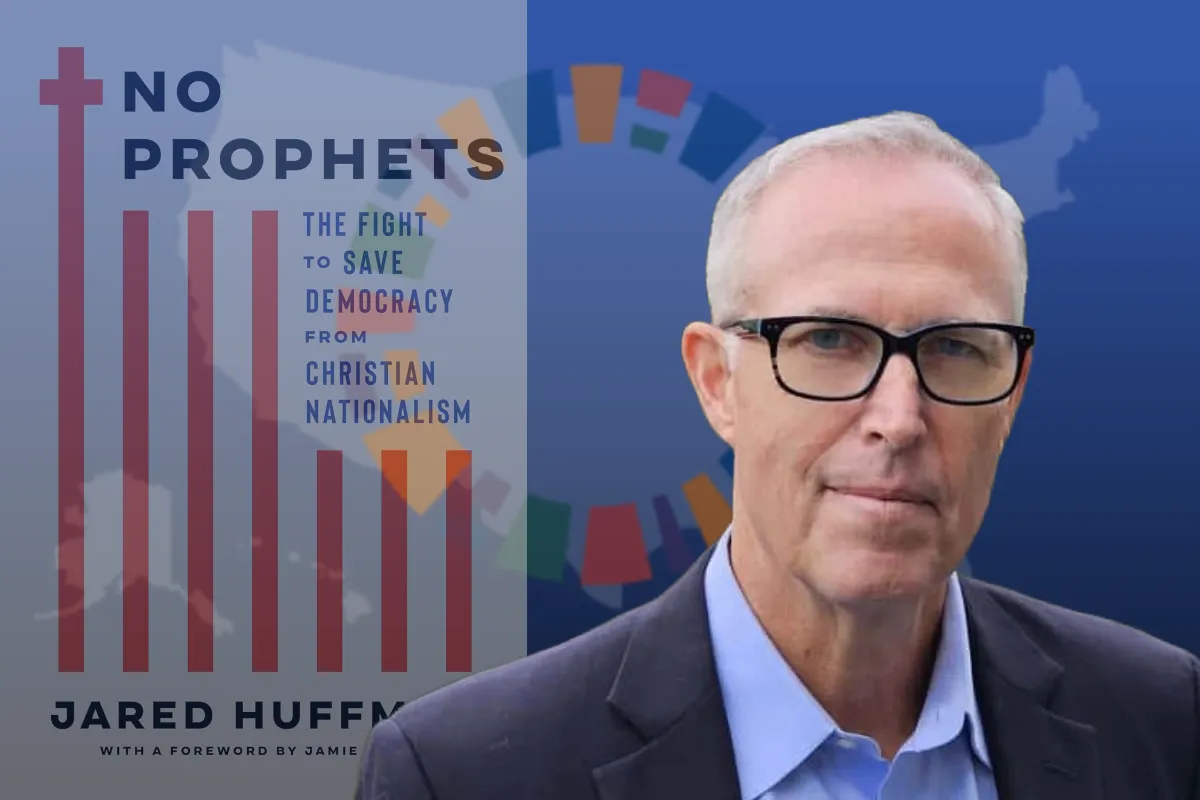
Congressman Jared Huffman: The Fight to Save Democracy From Christian Nationalism
The co-founder of the Congressional Freethought Caucus joins host Rev. Paul Brandeis Raushenbush to discuss how he's seen authoritarian impulses show up in our government and to share some of the insider stories featured in his best-selling new book, "No Prophets"